



CEO succession has always been one of the most significant decisions for Middle East automotive distributors, many of them longstanding family businesses. But the question of who should lead next has taken on new urgency as the role of the automotive CEO expands far beyond what it was even a decade ago.
In our previous article, we outlined the forces reshaping the region’s distributor landscape, from electrification to the rise of Chinese brands. In this piece, we focus on key questions centering on leadership succession: What kind of CEO is now required to thrive in the sector, and how should family-owned distributors rethink succession at a moment when the very nature of the role is being rewritten?
Based on our vast experience with the sector in the region, the traditional automotive CEO profile, rooted in operational expertise and OEM relationships, is no longer enough. The transformation underway demands leaders with different instincts, different capabilities, and, in many cases, a different relationship to the family that has historically shaped the business.
Three CEO Profiles for the Future
Three CEO Profiles for the Future
The profound transformation reshaping the Middle East’s automotive distribution sector has elevated the stakes of leadership like never before. The traditional CEO profile is no longer sufficient, and the question of who should guide family‑owned businesses through the coming decade of disruption requires a clearer understanding of the leadership models now in play.
To bring sharper definition to what’s needed, we outline three emerging CEO archetypes, offering families and boards a focused lens to match the right leader to their strategy and stage of transformation.
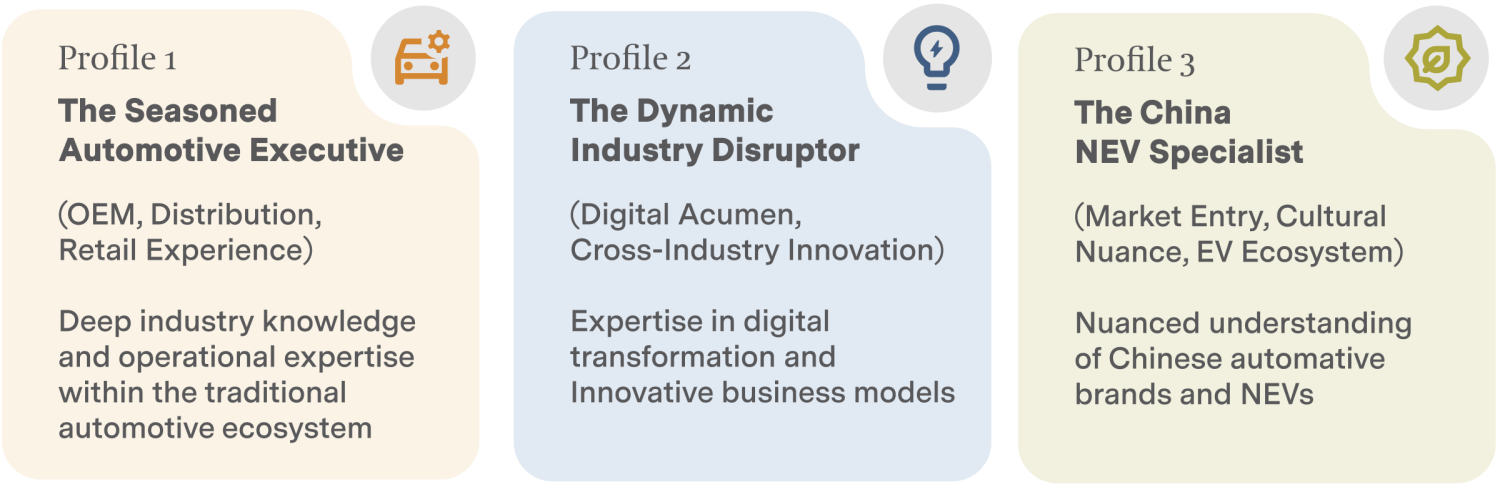
Profile 1: The Seasoned Automotive Executive (OEM, Distribution, Retail Experience)
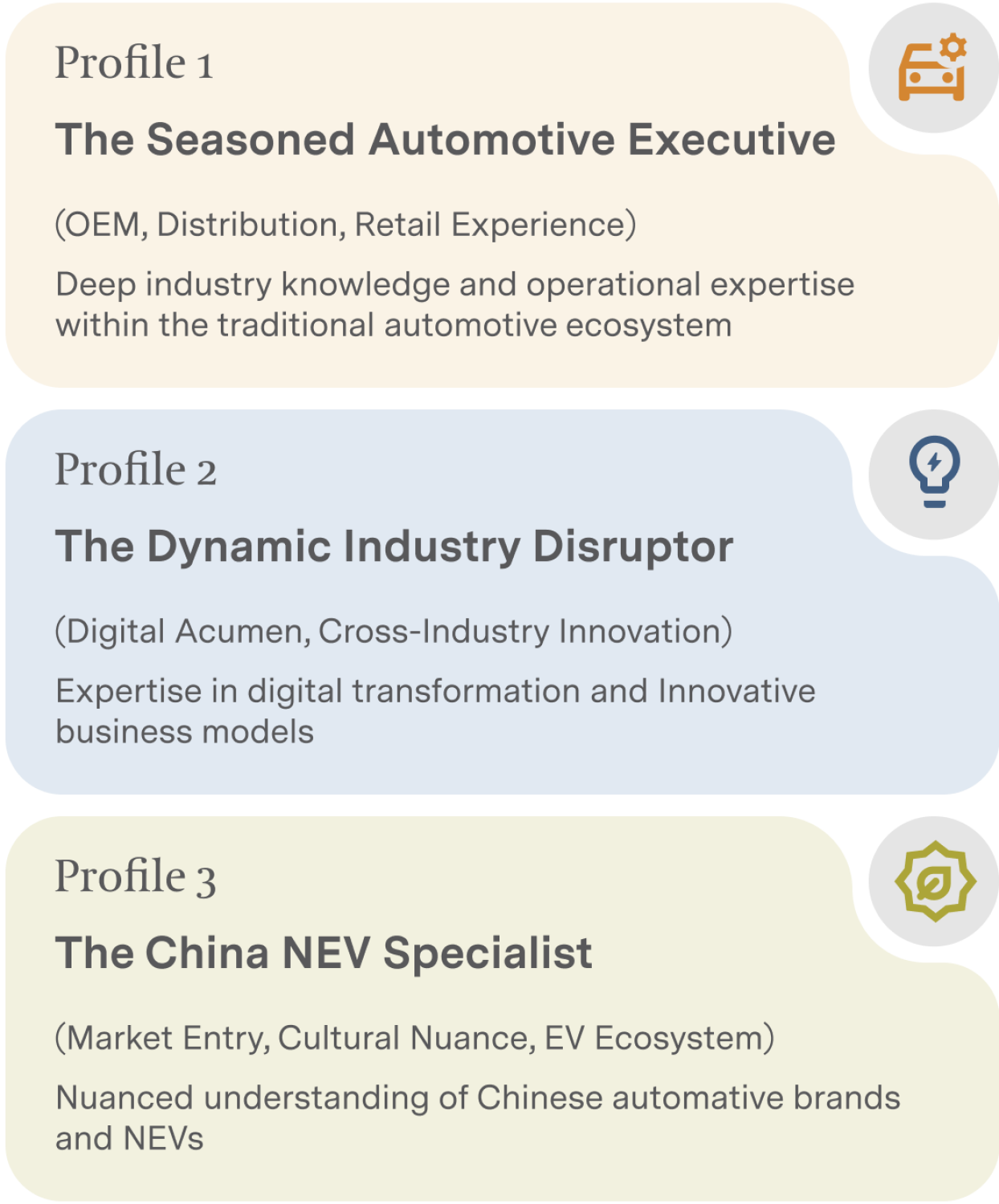
Profile 1: The Seasoned Automotive Executive (OEM, Distribution, Retail Experience)
This profile embodies deep industry knowledge, established networks, and a proven track record within the traditional automotive ecosystem. The value of this profile lies in its foundational strength. While the industry transforms, core distribution—the prevailing cash cow for practically all automotive distributors—still requires deep operational expertise.
Leaders with this background provide stability and understanding of existing profit engines. Their primary challenge is to leverage their profound industry knowledge to adapt the core business and seamlessly integrate new models, evolving into agents of change rather than just stewards of the status quo.
Profile 2: The Dynamic Industry Disruptor (Digital Acumen, Cross-Industry Innovation)
Profile 2: The Dynamic Industry Disruptor (Digital Acumen, Cross-Industry Innovation)
This CEO profile brings a fresh perspective, characterized by expertise in digital transformation, data analytics, and novel business model development. Such leaders understand how to harness high internet penetration for omnichannel sales, formalized used car channels, and vehicle subscription services.
Their experience, often from dynamic, digitally driven industries, injects crucial agility and innovation into the automotive sector. They are adept at leveraging digital technology for state-of-the-art operations, including e-commerce.
A CEO with strong digital acumen is not just an asset but a necessity to drive cultural shifts, embrace data-driven decision-making, and rapidly deploy new digital services. Their challenge lies in integrating digital innovation effectively without alienating the existing customer base or disrupting profitable legacy operations too abruptly.
Profile 3: The China Specialist (Market Entry, Cultural Nuance, EV Ecosystem)
Profile 3: The China Specialist (Market Entry, Cultural Nuance, EV Ecosystem)
This profile is uniquely positioned to navigate the complexities arising from the meteoric rise of Chinese automotive brands. A CEO with this background possesses a nuanced understanding of the Chinese OEM and product landscape, including its rapid innovation, competitive pricing, and overcapacity challenges. They bring experience in working with Chinese brands and are adept at navigating partnerships with them. They understand the stark differences and nuances in how the Chinese operate compared to their Western counterparts, both in terms of strategy and collaboration.
This profile serves as a "bridge builder" for a new geopolitical automotive order. A CEO with deep China expertise understands this complex interplay, acting as a crucial intermediary between the Middle Eastern distributor's local market understanding and the fast-moving Chinese OEM landscape. This profile is crucial for effective brand portfolio diversification and astute risk management, identifying promising partners and negotiating favorable terms. Their challenge is to successfully integrate these new brands and their distinct business models into an existing, often traditional, organizational structure.
Synthesizing the Ideal Leadership Attributes for Tomorrow's Automotive Distributor
Synthesizing the Ideal Leadership Attributes for Tomorrow's Automotive Distributor
The transformative pressures on automotive distributors in the Middle East necessitate a CEO with a multifaceted skillset that transcends any single profile. The ideal leader for this new era must embody a synthesis of attributes drawn from the seasoned automotive executive, the dynamic industry disruptor, and the China specialist. Such a leader must possess:
- Strategic Vision and Agility: The ability to anticipate rapid market shifts, adapt organizational strategy swiftly, and drive profound transformation.
- Digital Fluency: A command of omnichannel strategies, leveraging data for decision-making, and a keen understanding of how to embrace and deploy new technologies.
- Operational Excellence: A commitment to fostering lean and efficient processes, coupled with the ability to acquire, develop, and retain top talent.
- Financial Acumen: The capability to navigate narrowing margins, identify and cultivate new revenue streams, and manage complex financial relationships.
- Cross-Cultural Intelligence: A nuanced understanding of Chinese business approaches and culture, market entry dynamics, and international partnership intricacies.
- People Leadership and Change Management: The capacity to cultivate a thriving, customer-centric organizational culture, coach teams, and lead through significant change.
- Stakeholder Management: A strong ability to manage a complex set of stakeholders in a sometimes still opaque structure with limited or nascent formal governance.
These three CEO profiles represent distinct, yet critical, skill sets. The "ideal" CEO is less about a singular person and more about the leadership architecture that can drive complex transformation. This suggests that the ultimate competitive advantage lies in identifying a "hybrid" leader, or perhaps, a leader who can build a hybrid leadership team that collectively possesses these diverse capabilities.
The challenge for family-owned distributors is not just finding this rare individual, but crucially, empowering them within the existing family structure and being willing to bring in external talent to complement their skills. This might necessitate innovative leadership models, such as a co-CEO structure, the establishment of a strong independent board, or a clear delegation of authority that enables rapid, informed decision-making across diverse strategic domains.
The Added Complexity of Family Governance
The Added Complexity of Family Governance
For family-owned distributors, the challenge is not only identifying the right CEO, but empowering that leader within a governance model that must evolve alongside the business. Succession decisions often sit at the intersection of generational transitions, family expectations, and structures built for stability rather than agility.
Without clearer decision rights, stronger governance, and openness to external leadership, even the best-selected CEO will struggle to execute. Modernization of roles, governance, and expectations is now inseparable from the succession discussion itself.
What This Means for Leadership
What This Means for Leadership
The automotive sector in the Middle East is changing at a speed and scale without precedent. Electrification, software, shifting market structures, and the rise of Chinese brands all point toward a fundamentally different distribution landscape. In this context, selecting the next CEO is the defining strategic decision for the decade ahead.
The leaders who succeed will be those who combine operational credibility with digital agility and global awareness, especially with regard to China’s growing influence. More importantly, they will be those empowered by governance systems designed for the future, not the past.
Particularly for family-owned automotive distributors, the path forward is not merely about transitioning leadership. It is about choosing a CEO capable of shaping the future and building the organizational conditions that allow them to lead boldly.
Delve deeper: For broader context on the forces reshaping Middle East automotive distribution, see our companion article on industry transformation and governance.
