



Entrepreneurs don’t just think differently—they’re wired differently. What propels them forward is often the same force that, over time, can pull organizations off balance.
Our psychometric assessments of entrepreneurs worldwide reveal a distinctive profile: Founders tend to be imaginative, comfortable with change, and possess exceptional drive—a powerful combination that fuels entrepreneurial action. These strengths, however, often coincide with a lower inclination to follow direction and a reduced pause for risk, freeing founders from convention and enabling them to pursue opportunities others might overlook or avoid. At the same time, the data shows founders are less likely to invest in deep interpersonal relationships as a means of progress, which can create headwinds for collaboration and alignment as the business scales. Without complimentary team members and targeted coaching, these tendencies can ultimately place a founder’s vision at risk. Sustainable scaling demands more than generic leadership development; it requires tailored support systems designed to both reflect—and balance—the distinctive thinking and behaviors of founders.
Founders are widely seen as a certain "breed" of leader. They thrive in ambiguity, challenge convention, and pursues their vision with relentless energy. But as their organizations mature, some of these very traits can become obstacles to sustained, scalable growth. How do organizations scale without losing what made the founder and the foundation of the organization exceptional?
To explore this, we analyzed psychometric data from 16 highly impactful founders across North America and the UK. The data reveals a recurring profile, one that enables innovation and early-stage acceleration, yet can constrain leadership effectiveness, team alignment, and organizational development as complexity grows.
Key Traits that Drive Early Success But Cause Friction Later
Key Traits that Drive Early Success But Cause Friction Later
Founders consistently score exceptionally high in imaginative thinking (HDS), often generating unconventional ideas and envisioning possibilities beyond current constraints. They display higher than average openness to change (16PF), reflecting comfort with novelty, flexibility, and shifting direction. They also score high on curiosity (ELP), demonstrating a strong drive to seek new insights, experiences, and learning. Together, these markers suggest a thinking style that is exploratory, non-linear, and future-oriented. Founders are not merely problem solvers—they are problem re-framers, often approaching challenges with unconventional logic and a preference for novelty over tradition.
Conversely, traits associated with following established rules or pausing to manage risk tend to be much lower, indicating, as you’d expect, less deference to authority or standard processes and greater comfort moving quickly and taking bold bets. These qualities fuel innovation and momentum in early‑stage ventures but could introduce friction in collaboration, stakeholder alignment, and long‑term planning as the company scales and complexity increases. While comfort with spontaneity and pushing boundaries can galvanize teams and spark creativity, it can also result in inconsistency and weak follow‑through at the stage when structure and disciplined execution become essential.
When we look at founders through our proprietary model for assessing a leader’s capacity to continue growing as their organization scales, we focus on four core dimensions: determination, curiosity, insight, and engagement. What consistently stands out is that founders score especially high on determination—the drive to push through obstacles and take bold but considered risks—and on curiosity, reflected in a strong motivation to explore new ideas and keep learning. By contrast, insight—the ability to distil complexity into clear direction—and engagement—building alignment and momentum through others—tend to be less pronounced. These dimensions are often less central in the early act of creation but become increasingly important as organisations grow in size and complexity.
What This Means for the Organization
What This Means for the Organization
In environments that reward innovation, autonomy, and speed, these traits are prized. They can create momentum towards audacious goals and creative solutions. And they inspire a sense of empowerment to achieve in the face of adversity and doubt. Overall, it is the entrepreneur who can translate "Mission Possible.” They galvanize dreamers and warriors. Entrepreneurs can unblock and unlock, and they persist when others waver and tire. Entrepreneurs run headfirst into the future.
As organizations grow, the leadership requirements evolve—often demanding more intentional collaboration, clearer and less ambiguous operating structures, and strategic insight grounded in domain and contextual data.
Founders who continue to lead beyond the disruptive early years through the scale-up phase therefore have to evolve—not by suppressing their core traits, but by deepening their self-awareness and deliberately complementing their natural inclinations and drivers with new leadership capabilities. The leadership mandate shifts from generating momentum to orchestrating alignment, structure, and repeatable performance. To meet these demands, founders benefit from surrounding themselves with complementary talent that broadens their repertoire while preserving the creative vision and entrepreneurial edge that sparked the business.
The Founder+1 Model
The Founder+1 Model
One of the most effective ways to do this is through deliberate founder enhancement. Many high‑growth companies succeed because their founders’ partner with a strong “Number 2”—an operator, integrator, translator—one who brings discipline, structure, and cross‑functional alignment to balance the founder’s vision and pace. These leaders excel in execution rigor, stakeholder management, prioritization, and organizational cohesion. When paired well, the founder–operator dyad becomes a powerful engine: The founder continues to drive innovation and vision, while the “founder complement” ensures clarity, continuity, sustainable performance, and profitable growth. Designing teams through this lens—identifying where the founder profoundly spikes and where counterweights are valuable —is powerful as complexity increases.
Development Pathways
Development Pathways
This kind of evolution requires intentional development. There are several structured approaches that can help founders broaden their leadership range. One important area of focus is deep behavioral work. As founders scale with their organizations, many notice the “flip side” of their strengths. Structured developmental experiences help leaders bring these patterns to the surface, understand the required polarities within their ongoing leadership, and then experiment with new effective ways of operating. This work often becomes a foundation for leading with greater intentionality, resilience, and self-awareness. When a founder channels her/his determination and curiosity towards this growth, the results can be extraordinary.
Also helpful is to work deliberately on aligning leadership and team development with the company’s evolving strategy. As the business becomes more complex, leadership teams need to adapt how they collaborate, make decisions, and communicate—shifting from founder-centric execution to shared ownership and enterprise-level governance. This helps teams define the capabilities needed for the next stage of growth, identify misalignments between leadership behaviour and strategic direction, and build collective ways of working that support both creative vision and long-term scale. This (re)alignment is particularly critical during periods of rapid growth, diversification of products or geographies, or organizational redesign. Great founders anticipate this moment versus fight it, and they embrace the adaptation – which may include discomfort - for continued success.
Other development pathways focus on building the capabilities founders need as they move from hands-on operators to leaders of larger, more distributed organisations. This includes shifting from day-to-day execution to longer-term strategic thinking. It may require a significant identity shift for founders as well which is about influencing at scale, navigating conflict, and managing a composite of stakeholders. As founders make this transition, they can empower others in a way that creates a more sustainable – and perhaps less founder-dependent - culture and business.
These interventions, grounded in Egon Zehnder’s Assessment Model, support founders at a pivotal moment in their journey—from being the source of momentum to becoming the stewards of something larger than themselves. The aim is not to temper talent, but to better enable it to grow—so creativity scales, leadership deepens, and vision extends far beyond the founder.
Assessment Breakdown
Assessment Breakdown
We draw on three core psychometric instruments that underpin Egon Zehnder’s assessment methodology and provide a multidimensional view of personality, behavior, and potential to continue to grow as a leader:
- The Hogan Development Survey (HDS): Identifies the likelihood that dysfunctional behavior patterns will appear at work. It measures dispositions that can hinder a person’s ability to get along with others or get ahead in their role.
- The 16 Personality Factors (16PF): A comprehensive, evidence-based personality assessment that measures both nuanced primary traits and broader global factors. Its robust hierarchical structure provides deep insight into
- Executive Leadership Profile (ELP): Incorporates its Potential model, which assesses the energy with which leaders can develop in the future—and the pace at which they can do so.
Using these instruments, we analyzed psychometric data from 16 highly impactful founders across North America and the UK.
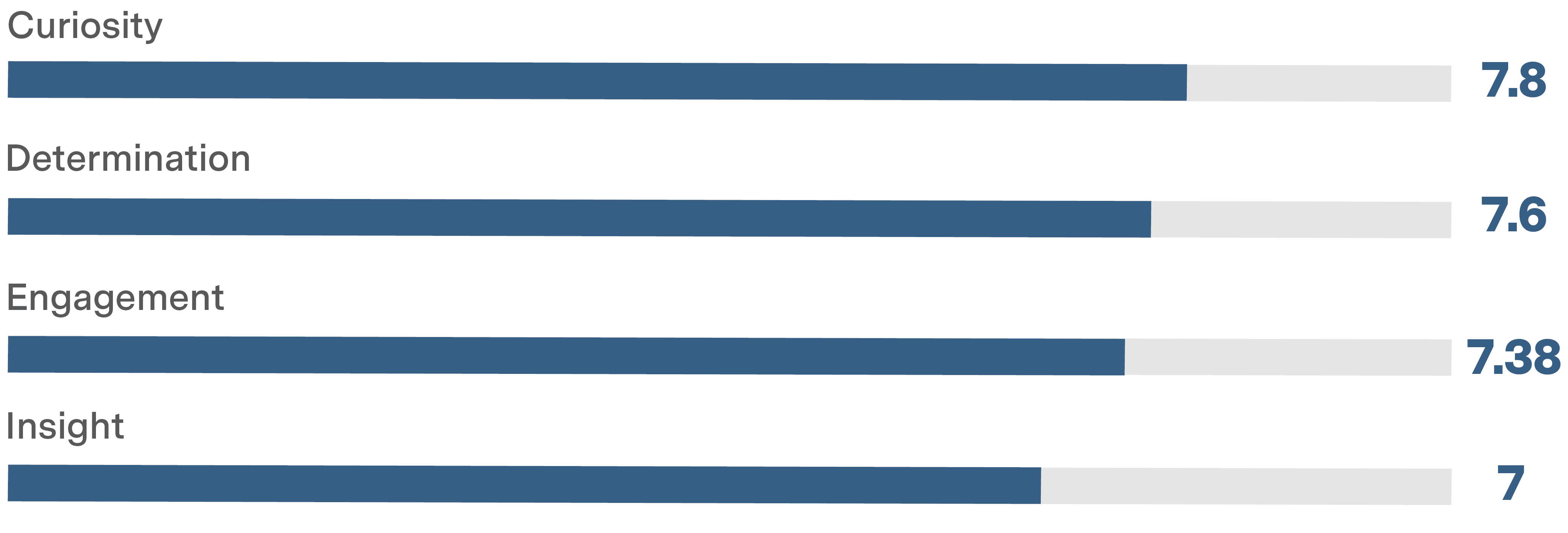
Egon Zehnder’s proprietary Potential scale outlines the energy with which leaders can develop in the future—and the pace at which they can do so. It predicts an individual’s motivation to grow and to take on responsibilities of greater scale and complexity across four dimensions:
- Curiosity: The energy with which one actively seeks new experiences, ideas, feedback, and knowledge—and applies these learnings to build new skills.
- Determination: The motivation to take intelligent risks, embrace challenge, demonstrate resilience, and recover quickly from setbacks.
- Engagement: The degree to which one uses both logic and emotion to connect with others, communicate a compelling vision, and build strong relationships.
- Insight: The drive to think in multiple ways—creatively, analytically, top down, and bottom up—to generate fresh understanding and new perspectives.
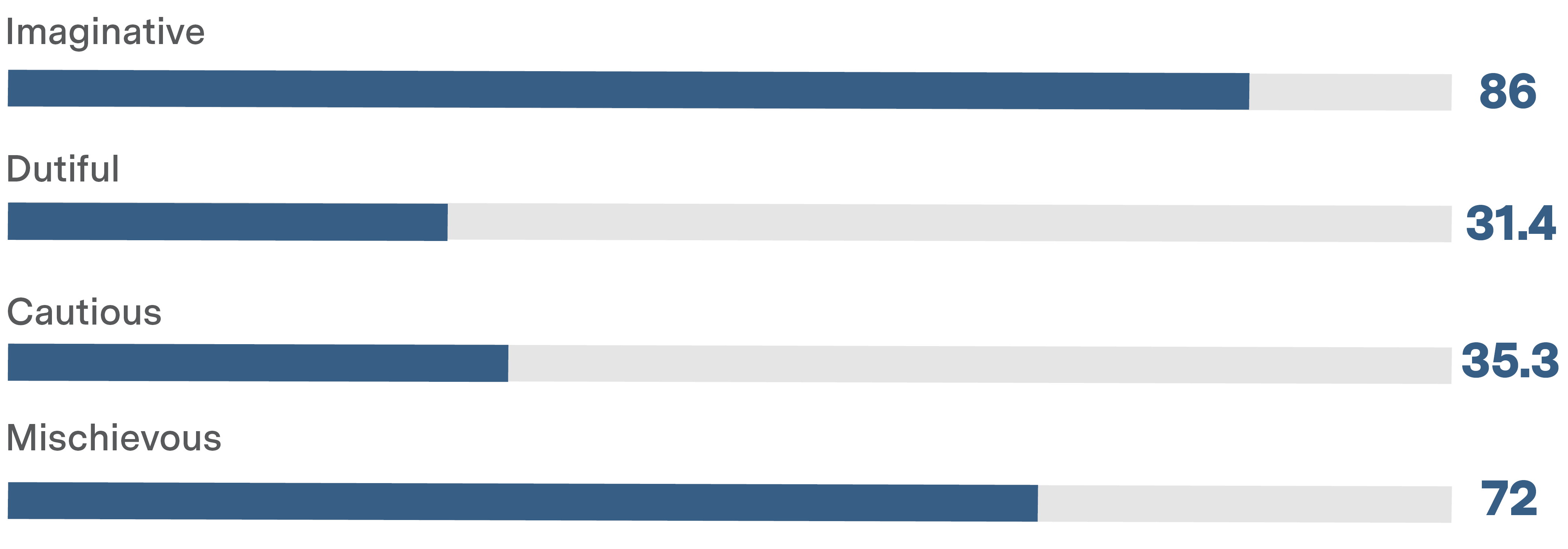
The Hogan Development Survey identifies the likelihood that behavior patterns will surface under stress or pressure—patterns that can undermine effectiveness, relationships, and decision‑making. It highlights tendencies that may interfere with a leader’s ability to get along with others or get ahead in complex organizational environments.
- High Imaginative: Reflects a strong preference for unconventional ideas and novel solutions. High scorers are creative, original thinkers who generate bold concepts and often challenge traditional approaches. This can make them hard to follow, or unaware of how their ideas impact others. They may shift focus quickly, and struggle with follow‑through, deadlines, or organizational processes. They often view themselves as uniquely insightful and may be less receptive to criticism.
- Moderately High Mischievous: Indicates a style that is quick-witted, and adventurous, paired with a willingness to take risks and push boundaries. These leaders can be energizing and persuasive but may act impulsively, overlook consequences, or disregard established norms and policies. They tend to recover quickly from mistakes but may not always consider how their actions affect others or the broader organization.
- Low Dutiful: Describes someone who is independent, self‑reliant, and comfortable challenging direction. Low scorers are confident, unbothered by criticism, and inclined to pursue their own ideas. While this enables bold, original thinking, it can also create unpredictability and make them appear dismissive of broader organizational context.
- Low Cautious: Signals decisiveness, comfort with risk, and openness to new challenges. These individuals move quickly, embrace innovation, and are not deterred by the possibility of mistakes. They may underestimate risks, overlook feedback, or appear insensitive to how their decisions impact others—particularly in high‑stakes environments where reflection and calibration are important.
Personality Traits | 16 Personality Factors
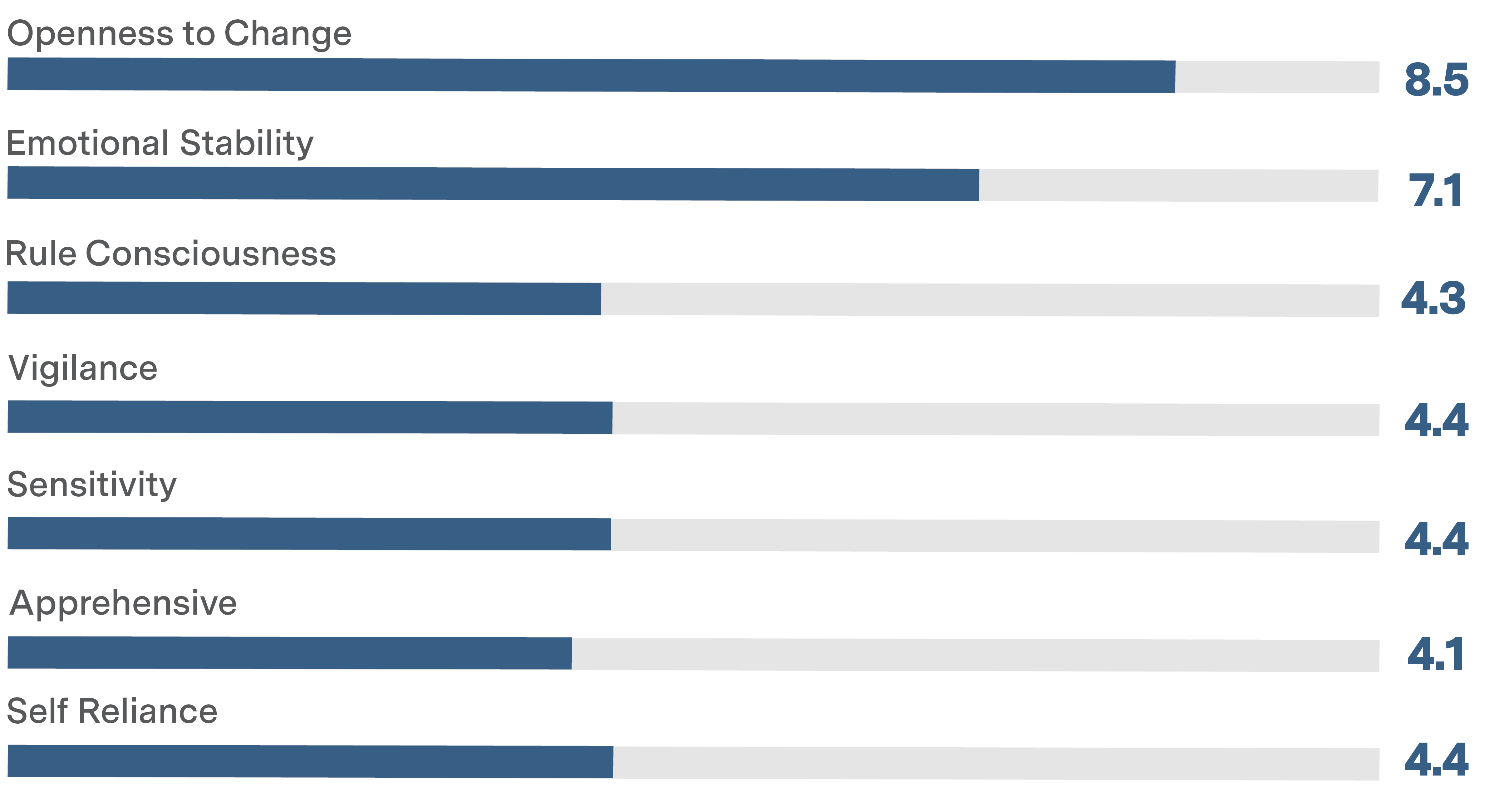
The 16 PF is a comprehensive, evidence-based personality assessment designed to capture both specific primary traits and broader global patterns. Its hierarchical structure provides organizations with deep insight into how individuals think and behave, supporting more precise development, role fit, and career guidance.
- Openness to Change: Readiness to question established approaches, try new methods, and think in original, innovative ways.
- Emotional Stability: The degree of calmness and resilience a person brings to life’s demands, and the extent to which they feel in control and satisfied in the present moment.
- Rule Consciousness: How closely a person adheres to rules, norms, and moral standards, and the extent to which they prefer structure and clear expectations.
- Vigilance: The level of trust an individual places in others, ranging from skeptical and guarded to open and trusting.
- Sensitivity: The extent to which personal values and feelings shape how someone interprets situations and makes decisions.
- Apprehension: The tendency to worry about personal adequacy or to blame oneself when things go wrong.
- Self-Reliance: How strongly an individual values independence, autonomy, and the freedom to make decisions without relying on group consensus.
