



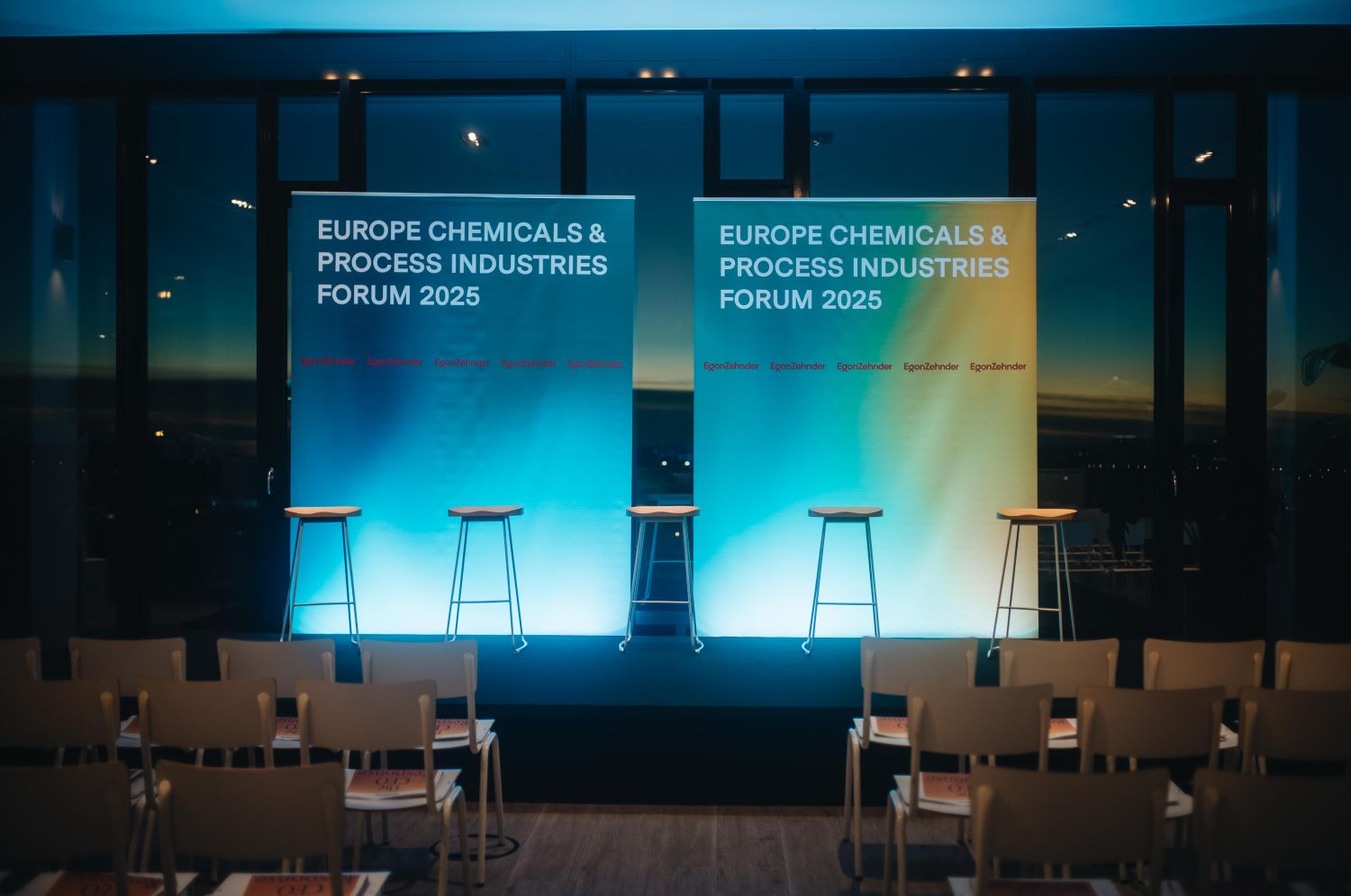
In Düsseldorf last December, senior executives from across the chemical and process industries gathered for a candid exchange on a question that has become existential: How can leaders create value in an increasingly volatile world? The European Chemical Forum brought together leaders from chemicals, ingredients, agrofood, building materials, and packaging to explore what it means to lead when uncertainty is not a passing storm but the permanent climate.
“Volatility is no longer a deviation from stability. It is the baseline,” said Egon Zehnder’s Amalia Brückner, pointing to geopolitical tensions, fragile supply networks, and accelerating sustainability demands as forces that have moved from trend to structural reality. In this environment, leadership is not about absorbing complexity but about transforming ambiguity into progress. Boards and CEOs are making judgment calls under radical uncertainty, where the quality of decisions defines the resilience of an organization.
Clarity and Focus: The CEO’s First Imperative
Clarity and Focus: The CEO’s First Imperative
One of the panelists emphasized that the starting point for resilience is ruthless clarity. Leaders must quickly assess what their organizations do best and act decisively to streamline portfolios. In cyclical businesses, distractions are costly, so sharpening focus on core strengths is essential.
He also stressed that cost discipline and regulatory insight have become strategic levers. Unlike two decades ago, regulatory affairs can no longer be delegated; CEOs themselves need to understand how regulation shapes markets and creates opportunities. Innovation, he added, is not something that can be paused and restarted at will; it must remain a continuous priority.
Efficiency: A Relentless Pursuit
Efficiency: A Relentless Pursuit
Another panelist reflected on recent years as a period marked more by value destruction than creation. The immediate challenge, he argued, is to halt further erosion while preparing for future opportunities. Efficiency, in his view, is the battlefield where companies win or lose. Even those that believe they are lean will find that efficiency requires constant attention, “like mowing the lawn,” as he put it. Beyond operational rigor, leaders must strike a balance between short-term survival and long-term innovation, making fewer but better choices.
Innovation Beyond Chemistry
Innovation Beyond Chemistry
The discussion moved beyond traditional R&D. One chair noted that while innovation once meant new chemistry, today the real differentiator is business model innovation. Companies cannot afford to spread themselves thin across multiple models and markets; instead, they must double down on the few that truly matter.
Governance was highlighted as a critical factor. Private equity boards, he observed, tend to bring speed and rigor, while public boards offer a longer-term perspective, each with its own advantages.
Capital Discipline and Cash Culture
Capital Discipline and Cash Culture
Access to capital was another recurring theme. One CEO underscored that the best source of funding is internal, through efficiencies and disciplined cash management, followed by customer-driven solutions. Working capital, he argued, is often underestimated, yet can be unlocked quickly with a private-equity-style approach marked by decisiveness and accountability.
Others reinforced this point, noting that true value creation depends on cash generation rather than EBITDA alone. To attract investment, companies must demonstrate their ability to generate sustainable cash flow, a capability many still struggle to master but remains imperative.
Technology and Transformation
Technology and Transformation
Despite immediate pressures, all panelists agreed that innovation remains the only viable path to growth. One CEO stressed that relying on market share gains is not enough; companies must invest in new technologies such as green chemistry, recycling, and AI.
Another panelist illustrated how technology and business model reinvention go hand in hand. Capturing full value from innovation often requires re-engineering the value chain and engaging directly with brand owners even if that disrupts traditional relationships. The panelist added that AI will soon become part of every employee’s daily work. The real question is whether AI will fundamentally reshape business models, and leaders must prepare for that possibility.
The Human Factor
The Human Factor
Beyond strategy and systems, leadership qualities came under scrutiny. One panelist distilled his formula into three essentials: proven competence, authenticity, and empathy. Another added stamina, noting that today’s leaders must recharge faster than lithium-ion batteries to keep pace with relentless demands. Adaptability was also highlighted as critical, with leadership styles shifting based on context—more directive in crises, more consensus-driven in stable times.
Generational dynamics added another layer of complexity. One CEO pointed out that many Gen Z professionals have never experienced a downturn, making coaching, mentoring, and development plans vital to sustaining engagement and confidence.
Balancing Horizons
Balancing Horizons
Reconciling short-term survival with long-term ambition remains one of leadership’s toughest challenges. A panelist likened it to treating a patient: immediate stabilization comes first, but the ultimate goal is a healthy future. That means prioritizing urgent needs while safeguarding strategic initiatives that define long-term success. Another added that clarity on “must-win battles” from day one helps organizations stay aligned even in turbulent times.
An Era of Permanent Volatility
An Era of Permanent Volatility
When asked to compare the current downturn with previous cycles, one CEO described it as the longest and most difficult of his career—driven not only by cyclical factors but by structural shifts in the industry. Another agreed on the severity but urged optimism, noting that every crisis feels unprecedented, yet each brings opportunities for reinvention.
As the evening closed, one insight resonated: Volatility is not a temporary phase; it is a permanent condition. Leadership in this environment demands clarity of focus, disciplined execution, and bold innovation. Or, as one panelist summed it up, opportunities exist, but they are “very good at hiding.”

Chemical & Process Industries Forum
The premier global forum where chemical and process industry leaders connect, exchange insights, and shape what comes next.
