


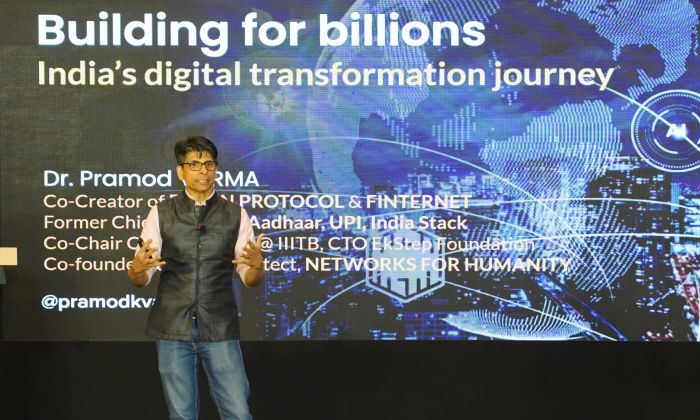
For nearly two decades, India has been gradually solidifying its reputation as an unexpected leader in digital public infrastructure (DPI) innovation, most notably through the development and refinement of India Stack, a first-of-its-kind, open-source suite of advanced payment, identity, and data and asset management solutions. But what are the underlying strategies that continue to drive technological evolution in the country, and what can banking and insurance leaders learn from India Stack’s story as they navigate the complex integration of core DPI technologies and rapid acceleration of artificial intelligence (AI)?
As part of Egon Zehnder’s Directors Development Program, Dr. Pramod Varma, former chief architect of foundational digital identity platform, Aadhaar, revealed some of the guiding principles behind India Stack’s success, as well as how the banking and insurance sectors can leverage a similar mindset to their advantage. Here are a few key insights from the presentation made by him.
Designing for the Future
Designing for the Future
Whether we’re talking about platforms like Aadhaar, DigiLocker, or the United Payments Interface (UPI), one of the most noteworthy aspects of India Stack and its various components has been the defiance of expectations. In fact, as Pramod noted, these initiatives began in the mid- to late-2000s when the idea of a digital approach to public infrastructure was still considered unconventional and even controversial, despite the staggering growth and compounding impacts of the internet on society and global markets.
Of course, much of the skepticism around India’s strategy has since dissipated, being largely replaced by a sense of gratitude for Pramod and others’ decision to move forward with their vision. After all, very few could have anticipated that tools like Aadhaar and UPI alone would be responsible for supporting exponential tax collection growth or expanding banking access to hundreds of millions of citizens around the country, the latter of which would have taken up to five decades in the absence of digitalization, according to the Bureau of International Settlements (BIS).
In Pramod’s view, beyond the effectiveness of the technology itself, the success of these platforms is a result of their creators’ ability to see the trends forming around them and design for the future, as opposed to trying to solve new problems exclusively with existing or outdated knowledge and strategies. And this mindset can serve as an increasingly valuable blueprint for banking and insurance leaders, particularly as we approach the intersection of multiple, rapidly advancing technologies, whose collective impact stands to rival and even surpass that of the first industrial revolution.
“Tech is coming down fast, and between AI, decentralization, connectivity, and so many others, we are approaching that cusp where multiple trends will eventually collide,” said Pramod. “So, as a mentor of mine used to say, the trend is your friend. If you’re able to watch and understand the trend, then you can meet it at the appropriate time. But if you resist the trend and fail to watch and understand it, you’ll either fall behind or end up designing for the past.”
The Power of Extreme Minimalism
The Power of Extreme Minimalism
When strategizing around digital transformation, whether in banking or insurance, it can be incredibly easy to get caught up in the sheer complexity of it all. But while it’s true that many aspects of modern technology are inherently complex, Pramod suggests that even some of the most seemingly complicated problems can have unexpectedly simple solutions.
For example, Pramod explained how simplicity and engagement with basic first principles enabled the creation and widespread implementation of Aadhaar, a country-wide identity card and verification program almost incomprehensibly large in terms of scale. More specifically, the authors realized early on that the problem of assigning ID cards and bank accounts to everyone in the country was only complex because it involved printing, photocopying, and distributing physical documents, whereas issuing a digital version would be equally secure and verifiable, as well as infinitely more efficient in terms of execution.
“The reason Aadhaar was such a success both operationally and politically was extreme minimalism,” he said. “It was all API-driven and only had two interfaces, which made it easy to roll out and mitigated concerns around data collection and privacy from day one.
Similarly, it was the same high-level logic that allowed for the conception and success of UPI, which now facilitates nearly 19 billion transactions in India every month. And again, as Pramod explained, this seemingly complex undertaking was largely achieved by surveying trends and asking straightforward questions, which resulted in even the system itself being relatively simple and lean in terms of design.
“What happened was we looked around and simply asked, ‘if you can move your email from Outlook to Gmail or send instant messages on WhatsApp, why can’t you send money? What’s the big deal?’, he said. “And it was this first principles thinking that ended up being key to imagining UPI from the ground up, and people are often surprised to learn we created the world’s biggest interoperable payment playground with a design protocol that was only 1.5 pages long. It really was a brilliantly simple solution.”
Existing and Emerging Challenges
Existing and Emerging Challenges
Although observing all relevant trends and leveraging extreme minimalism are crucial to building innovative systems and products, Pramod also discussed the importance of applying these high-level strategies to address a variety of existing and potentially emerging challenges, many of which are grounded in uncertainty and unique to our rapidly evolving technological landscape.
For one, Pramod noted that the widespread adoption of AI seems to be resulting in a higher risk of identity and financial fraud, which is somewhat paradoxical considering one of the primary objectives of digitalization has been to reduce such risks. “When verification of identity or assets is all paper, it can easily be faked, which is why we embraced digital and decided to move toward systems defined by high trust, low-cost compliance and verification,” he said. “But interestingly, the world is now moving toward a high-speed ability to fake, with more and more people using AI to create fake claims, receipts, and other documents. And this is why creating and utilizing cryptographically secure platforms like DigiLocker, as well as figuring out a more coordinated approach among banks to detect fraud, is becoming so important.”
Additionally, Pramod encouraged India’s business leaders to actively look for problems to be solved within India Stack and the country’s broader digital economy. For example, while India has had massive success in the realm of payments, it still has an extremely limited transaction economy, with only 8% of the country’s annual payments being tied to B2C e-commerce transactions. Pramod views this and other similar economic hurdles as being a product of persistent fragmentation, however he also believes that India may once again be facing a critical opportunity to emerge as an unanticipated leader in market innovation.
“There is so much growth yet to happen and new solutions to be found in this very unique combination of advancing technologies, and this is what India’s model is about,” he said. “It’s not about the success of Aadhaar or UPI. It’s about the success of the idea that bold innovation can take us forward, and that we have a chance to completely change the way our society interacts with and helps to shape the future of the global economy.”
