


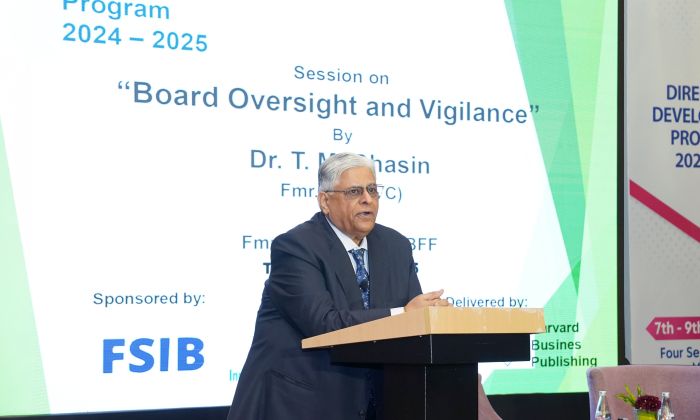
In a session that combined institutional insight with practical wisdom, Dr. T.M. Bhasin—former Vigilance Commissioner of India—delivered a lecture on the evolving role of vigilance in public governance. Addressing board members as part of Egon Zehnder’s Directors Development Program, Dr. Bhasin offered behind-the-scenes look at the mechanisms of oversight that shape decision-making in public sector institutions, and the critical role directors play in ensuring integrity and accountability.
With a career spanning over four decades—including leadership roles at Indian Bank, the Indian Banks’ Association, and the Central Vigilance Commission—Dr. Bhasin brought both gravitas and clarity to a topic often shrouded in apprehension. “Vigilance is not a hostile function,” he emphasized. “It is your function. It is symbiotic, synergistic, and complementary to good governance.”
Demystifying the “Three Cs”: CVC, CBI, and CAG
Demystifying the “Three Cs”: CVC, CBI, and CAG
Dr. Bhasin began by addressing what he calls the “three Cs”: Comptroller and Auditor General (CAG), the Central Vigilance Commission (CVC), and the Central Bureau of Investigation (CBI). “In banking, CAG is not applicable since we don’t receive budgetary allocations,” he clarified. “But CVC and CBI are very much part of the ecosystem—and they are often misunderstood.”
He traced the origins of the CVC to the 1963 Santhanam Committee report, which followed a scandal involving public sector investments in the Mundra Group. The committee’s recommendations led to the creation of the CVC as an apex integrity institution. “The mandate was clear,” Dr. Bhasin said. “To protect the honest and punish the corrupt.”
Over time, the CVC evolved from a one-member advisory body to a three-member statutory commission with quasi-judicial powers. “The Supreme Court’s 1997 judgment in the Hawala case was pivotal,” he noted. “It mandated statutory status and multi-member composition to ensure objectivity.”
From Fear to Facilitation: Reforms in Vigilance Practice
From Fear to Facilitation: Reforms in Vigilance Practice
A major theme of the session was the transformation of vigilance from a punitive to a preventive function. “Until 2014, vigilance was a black box,” Dr. Bhasin recalled. “Anonymous complaints were weaponized, often surfacing during promotions or foreign postings. It created a climate of fear.”
This changed with the introduction of a Know Your Complainant (KYC) protocol. “We said: if a complaint is anonymous or pseudonymous, it goes straight to the dustbin,” he said. “And for named complaints, we verify the identity of the complainant. This brought down the number of complaints from over 100,000 to just 8,000 in a year.”
This reform, coupled with digitization and streamlined processes, significantly reduced red tape and restored confidence among public servants. “The aim is not to paralyze decision-making,” he stressed. “It is to protect those who act in good faith.”
Section 17A: A Legal Safety Net
Section 17A: A Legal Safety Net
One of the most consequential reforms discussed was the 2018 amendment to the Prevention of Corruption Act, introducing Section 17A. This provision requires prior approval from the competent authority before initiating any investigation against a public servant. “This was a watershed moment,” Dr. Bhasin said. “It gave officers the confidence to take bold decisions without fear of retrospective scrutiny.”
He emphasized that this protection is not a shield for wrongdoing but a safeguard for honest decision-making. “The goal is to ensure that the honest can work fearlessly, and the corrupt are punished promptly,” he said, quoting the Vigilance Manual.
The Advisory Board for Banking and Financial Frauds (ABBF)
The Advisory Board for Banking and Financial Frauds (ABBF)
To further insulate bankers from undue harassment, the government revived the Advisory Board for Banking and Financial Frauds (ABBF) in 2019. Dr. Bhasin served as its first chair. The board reviews fraud cases involving loans above ₹3 crore and assesses whether there is any staff accountability.
“During my tenure, only 8% of cases showed any wrongdoing by bank officials,” he shared. “In most cases, the fraud was committed by the borrower, not the banker. The ABBF acts as a safety wall, ensuring that honest mistakes are not criminalized.”
The board’s recommendations are shared with the concerned bank, the CBI, and the Department of Financial Services, ensuring transparency and consistency in handling fraud cases.
The Role of Directors: Proactive Oversight
The Role of Directors: Proactive Oversight
For board members, Dr. Bhasin’s message was unequivocal: vigilance is a strategic function that must be embedded in the board’s oversight responsibilities. “You should keep your ears to the ground and your antenna up,” he advised. “Engage regularly with your Chief Risk Officer, Head of Internal Audit, Compliance Officer, and Internal Ombudsman.”
He recommended quarterly interactions between the CEO and the Chief Vigilance Officer (CVO), as mandated by the CVC manual. “This dialogue ensures that issues are surfaced early, and corrective actions are taken before they escalate,” he said.
Dr. Bhasin also encouraged directors to support systemic improvements in procurement, tendering, and compliance. “The Integrity Pact, developed with Transparency International, and the appointment of Independent External Monitors (IEMs) have brought a new level of fairness to public procurement,” he noted.
Whistleblower Protection: A Critical Tool
Whistleblower Protection: A Critical Tool
The session also highlighted the importance of whistleblower mechanisms. Dr. Bhasin recounted a case involving Cadbury India, where a whistleblower exposed a tax evasion scheme that led to a recovery of over ₹1,000 crore. “We summoned the whistleblower, verified the documents, and took swift action,” he said. “This is the power of the Public Interest Disclosure and Protection of Informers (PIDPI) resolution.”
He emphasized that whistleblowers are now protected under law, and the CVC can request police protection for them. “Bribery thrives in secrecy. Whistleblowers are our eyes and ears,” he said.
Legal Developments and Judicial Clarity
Legal Developments and Judicial Clarity
Dr. Bhasin also reviewed recent Supreme Court judgments that have clarified the legal landscape. In the SBI vs. Rajesh Agrawal case, the Court ruled that borrowers must be given a show-cause notice before being declared fraudulent. However, in CBI vs. Surendra Patwa, the Court affirmed that criminal proceedings could continue even if a fraud classification is overturned.
“These rulings underscore the need for procedural fairness while maintaining accountability,” he said. “They also reinforce the importance of documentation and transparency in decision-making.”
Practical Takeaways for Board Members
Practical Takeaways for Board Members
Dr. Bhasin concluded with a set of actionable recommendations for directors:
- Act swiftly on audit and inspection findings to prevent escalation.
- Support systemic improvements in areas where procedural gaps are identified.
- Ensure timely and complete cooperation with investigative agencies.
- Champion a culture of integrity by reinforcing ethical behavior at all levels.
- Learn to say no to actions that are not legal or outside delegated powers.
He also encouraged directors to view vigilance as a partner in governance. “Rather than focusing solely on punitive aspects, we must promote a culture of preventive and participative vigilance,” he said. “This will lead to better performance, greater customer satisfaction, and enhanced institutional credibility.”
Final Reflections
Final Reflections
Dr. Bhasin’s session was a masterclass in the architecture of integrity. It offered board members not just a refresher on vigilance mechanisms, but a strategic lens through which to view their own roles. As organizations navigate increasing regulatory scrutiny and stakeholder expectations, the principles of transparency, fairness, and accountability are more relevant than ever.
“Vigilance is not about fear,” Dr. Bhasin concluded. “It is about foresight. And it is your ally in building resilient, ethical institutions.”
