


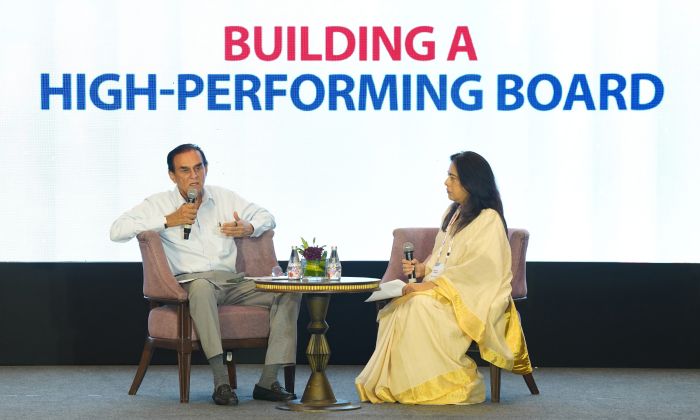
What qualities and processes characterize an effective and fine-tuned boardroom? As part of its Directors Development Program by Egon Zehnder, Harsh Mariwala, chair of Marico, and current and former member of several other boards, was in conversation with Namrita Jhangiani, Partner at Egon Zehnder, on building a high-performing board. During the session, Mariwala discussed what qualities and responsibilities make for effective board members, how those have changed over time, and what the future may hold for directors overseeing their companies.
How The Functions of the Board Have Evolved
How The Functions of the Board Have Evolved
Mariwala began by describing his early board experiences, in which the boardroom was mostly “yes men” who simply nodded in agreement with management’s reports. A typical meeting, he said, would only last one or two hours. “But since then, things have changed dramatically,” said Mariwala. Now, selecting board members is not merely about picking familiar and friendly faces. To assemble a high-performing board, member identification must start with defining competencies: the skills and expertise the company needs to have on the board, whether they be marketing, distribution, finance, or human resources, to name a few.
Even after selecting members, focus on competencies doesn’t end. Mariwala mentioned periodic review of members, both written out and talked over, to gauge insights into how each member’s expertise is fitting in with the overall makeup of the board. This can reveal blind spots in certain areas where the board would benefit from more expertise, and also potential friction points between members, such as when an expert in one competency tends to dominate conversations and sideline other members. In those situations, it’s up to the chair to guide, debate and make sure each board member gets a chance to participate. “The person who is the dominant or expert on that subject gets a chance to speak,” said Mariwala. “But you go in the rotation where you ask others to speak. In the end these small changes also make a big difference.”
Clarifying organizational strategy
Clarifying organizational strategy
Boards are supposed to think of the big picture behind their firms—the guiding strategy that management is tasked with executing. But that strategy may not be fully clear to members who, rightly, don’t enmesh themselves in the company’s day-to-day operations.
Mariwala saw this dynamic play out in past boardroom experiences. The solution was a two-page strategy document shared with the board that gives a clear picture of the “what” and “why” behind the vision. “It's a very simple two-page document which talks about: What is our business?” he explained. “What should it be? What shall we do over next few years? What we won't do and why we won't do it, and why will we win in the marketplace?”
It’s important that this document be reviewed and updated yearly to reflect an evolving business environment. “You can't have a strategy which is fixated for a period of one or two or three or five years,” Mariwala said. “The strategy document is not cast in stone.”
Building Trust in the Boardroom
Building Trust in the Boardroom
Trust is key across any organization, and across all its multiple parts: between the board members, the chair, independent directors, the management team, the CEO, and others. And as Mariwala cautioned, “That trust will not happen automatically.”
Building trust begins in the boardroom with selecting members who are able to work well in teams, debate fairly, and arrive at a consensus. And when it comes to building trust between the board and management, a culture of transparent information-sharing is critical to ensure both sides feel comfortable sharing concerns or problems. “You want to be in a situation where the management is looking forward to the board meetings, and that will only happen when there is high degree of trust and contribution,” said Mariwala. “A feeling that we are all in it together if there is a crisis.”
Encouraging interactions between board members and management outside of regularly scheduled meetings can help here. For example, a marketing manager in the company should be able to consult with the board’s marketing expert one-on-one, outside of the boardroom. Such connections can form a type of mentorship bond between an earlier-career employee and an experienced board member.
“The management team members should want to go to that board member for some advice,” said Mariwala. “You need to build that trust so that the management team interacts with the board.”
Distinguish Management Priorities from Board Oversight
Distinguish Management Priorities from Board Oversight
Strong connections between management and the board are helpful, but not if board members end up playing a dominant role in the company’s day-to-day operations. When questions arise, Mariwala said, it’s up to management to make decisions on the best course of action, and for the board to critique those decisions. “So, you critique that strategy: ‘Okay, this is not good. Why don't you look at this?’” he said. “And then throw the ball back in the management’s court in terms of looking at all these issues based on the feedback and come back to us.”
In explaining this board role, Mariwala made sure to distinguish between “critiquing” management and “criticizing” management: “Critique is saying that instead of doing this, why do you do it this way? Criticizing is saying, ‘No, your strategy is terrible.’ The moment you do that, there is a demotivation within the management team. You don't want that to happen.”
Boards should also think about priorities as either short or long term and arrive at a balance between the two. For example, reinvesting immediate profits into a long-run strategy, thus braiding focus across the two-time horizons. “There is some degree of discipline which comes in while looking at short term and long term, but everything cannot be decided through this kind of a policy,” said Mariwala. “You need to be a little flexible.”
The Future of the Boardroom
The Future of the Boardroom
As Mariwala led off with stating, the way boards function today is quite different than it was in decades prior. And looking further into the future, board members’ responsibilities are poised to change even more dramatically.
Required competencies in digital fields will only increase for board members, especially as generative artificial intelligence becomes more integral to companies’ functions. Meanwhile, geopolitical developments can rapidly shift board priorities and how they decide to chart a course for their firms. And finally, board members will have to become increasingly conscious of environmental, social, and governance (ESG) as well as diversity goals, and how they impact internal operations and external perceptions.
One thing that won’t change is Mariwala’s philosophy that the best boards are engaged boards. This means identifying conflicts, managing solutions, and creating an environment where both directors and management are working at the peak of their performance. Said Mariwala: “People should enjoy working at the company.”
