


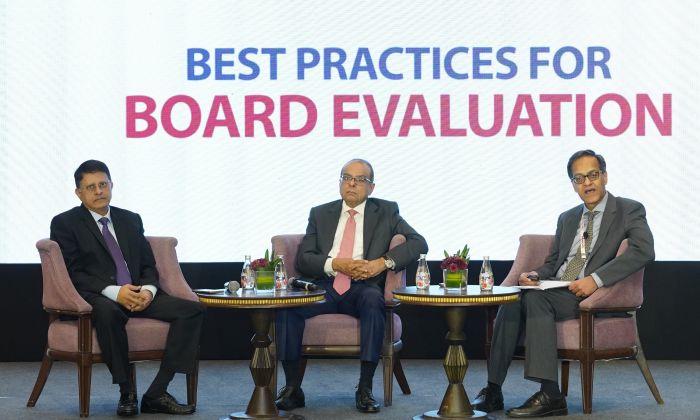
Amid growing scrutiny and expectations, the role of boards has expanded well beyond governance and oversight. At the heart of effective board performance lies the ability to engage in honest self-reflection and continuous improvement. In a recent session of Egon Zehnder’s Directors Development Program, Sanjiv Sachar, former NRC Chair, HDFC Bank & former Partner, Egon Zehnder and Milind Sarwate, founder & CEO, Increate Value Advisors were part of a panel discussion moderated by Darpan Kalra, Partner, Egon Zehnder, where they offered a candid exploration into how boards can approach evaluation not as a compliance exercise, but as a strategic enabler.
Their conversation was rooted in decades of lived experience across executive and non-executive roles, and across boards of varying maturity, ownership structures, and regulatory contexts.
The Purpose Behind Evaluation
The Purpose Behind Evaluation
According to Sarwate, the effectiveness of any board evaluation hinges on its intent. He challenged the audience to reflect on why the exercise is undertaken in the first place: “Why are you doing the board evaluation exercise? Why are you interested in a board review? And to my mind, that drives a lot of stuff thereafter.”
When the objective is merely to fulfill regulatory obligations, the result is often superficial: questionnaires are circulated, responses tallied, and little else follows. In these cases, as he explained, the process is typically led by the company secretary, with little engagement from leadership. “Somebody picks up a ready questionnaire, administers it to the board, chases board members to somehow respond and collates the information. It is cursorily presented and filed, and everything is good because the company has complied with law.”
In contrast, when the driving force is a desire to enhance board contribution and effectiveness, the tone and quality shift entirely. Promoters or NRC Chairs take ownership. The board becomes a learning organism. The evaluation turns into a lever for transformation. And the distinction between compliance and commitment sets the foundation for the entire exercise.
“If the driver is that I should get value out of the board, and the review is a very good juncture for me to find out what's working well, what's not working well and how do I improve things. The process is then driven with application of mind and with a lot of discern as to what can be done to improve the board.”
Board Culture and Real-Time Feedback
Board Culture and Real-Time Feedback
Sanjiv Sachar emphasized that culture is the invisible force that shapes the value of board evaluations. He underscored that without an environment of trust, openness, and humility, even the best-designed evaluation frameworks will falter. “If trust is there in the board, I am very confident, and my experience has been that the board evaluation happens in the true sense it should be.”
He went further, highlighting the value of continuous, real-time feedback over annual or end-of-cycle reviews: “Sure, the statutory requirement is annual but to be an effective board evaluation, it should be real time.”
He recalled his experience at HDFC Bank, where a mismatch between the volume of agenda items and the quality of discussion led to an immediate, collective push to restructure meetings: “So, believe it or not, I don't know whether it still continues, but at the time when I left, there were 11 board meetings and 11 Audit Committee meetings and there were six or seven NRC meetings. And full day and the whole composition, the whole quality of the discussion and the decision making completely changed.”
This example underscored a key point: a culture that encourages feedback and acts on it can dramatically enhance board performance.
Structure, Design, and the Value of Dialogue and Feedback
Structure, Design, and the Value of Dialogue and Feedback
Sarwate offered a granular view of how boards can enhance the mechanics of evaluation. Timing matters. So does the design of questionnaires, scales, and language. But above all, boards must move beyond tick-the-box surveys to create space for dialogue. “There is usually a number scale given along with each question, but they affect the score and then the score becomes a reality.”
He cautioned against “yes-sir” formats and encouraged careful question framing, avoiding scales that default to mediocrity. But more importantly, he championed the power of conversation over data alone: “What I have found useful is when there has been a human interaction during the evaluation, not just a clinical form filling, somebody had sat with the board members and almost eked out the insights. That process becomes really the best one.” In his view, involving a neutral external facilitator can help unlock those insights by ensuring psychological safety and encouraging honest reflection.
Sanjiv elaborated on the emotional complexity of feedback in the boardroom. He shared a moment where a board member’s disruptive behavior was addressed not through confrontation, but through a well-structured, situation-based dialogue: “The most effective discussions have happened when you wanted to give feedback an individual, and you gave a situation.”
He reminded the group that effective feedback is specific, behavioral, and grounded in examples. And it must be followed by support and, if necessary, accountability: “Monitoring is very important because if the person is not improving, then you are not going to wait till the next appraisal.”
The Role of Executives in the Process
The Role of Executives in the Process
Both speakers advocated for involving executives, both in evaluating the board and being evaluated by it. Sarwate recalled his dual perspective as CFO/CHRO and later board member: “I have participated in exercises as an executive, and I have participated in a board evaluation also as a board member, where the executives also evaluated me. So, I have both perspectives, and I find that it makes a big difference.”
He noted that executives have a unique vantage point: they are constantly present, observing directors not just in meetings but in how they prepare, interact, and add value. Their insights can offer a powerful mirror to the board’s impact. “If I had the limitation of having a single question in the board evaluation, I would only put a question as: does this board or how much value does this board add to you?”
Sanjiv emphasized that strong board-management relationships go beyond formal interactions. He described practices like pre-meeting informal gatherings or casual check-ins during city visits – gestures that build rapport and surface unspoken insights. “It is not work related. It is no presentations, it is just to know them as individuals.”
Embedding Reflection, Trust, and Follow-Through
Embedding Reflection, Trust, and Follow-Through
As the discussion deepened, one message emerged with clarity: board evaluations are most powerful when they go beyond forms and scores and foster authentic conversation and cultural introspection. “The conversation with them is way more important than necessarily the question,” one panelist noted, emphasizing the value of qualitative insight over box-ticking.
The role of committees also took center stage. “The role of the committees has become very, very critical,” Sanjiv remarked, adding that rigorous evaluation practices should extend beyond the board to its substructures. Creating “a good charter for each committee” – one that balances statutory duties with value-driven objectives – and aligning meeting agendas to those charters was cited as a best practice to maintain focus and accountability.
A theme that resonated strongly was the importance of culture and tone – both in board dynamics and in board-management interactions. Milind shared a principle from his Marico days: “respectful equalisation,” which urges board members and executives to approach one another as professional peers. “Board members are not specially made by God,” he quipped, reminding directors that effective oversight requires mutual respect, not hierarchy.
Ultimately, effective evaluations don’t stop with feedback – they translate into action. As the session concluded, participants were reminded that evaluation is not a ritual – it is a vital lever for culture, alignment, and long-term performance. Milind urged boards to ensure “some kind of formality to the outcome,” such as a summary of what to start, stop, or modify. Sanjiv closed with a call to vigilance: “The board evaluation with honesty is very critical. If you don’t have real time, it’ll be too late.”
