


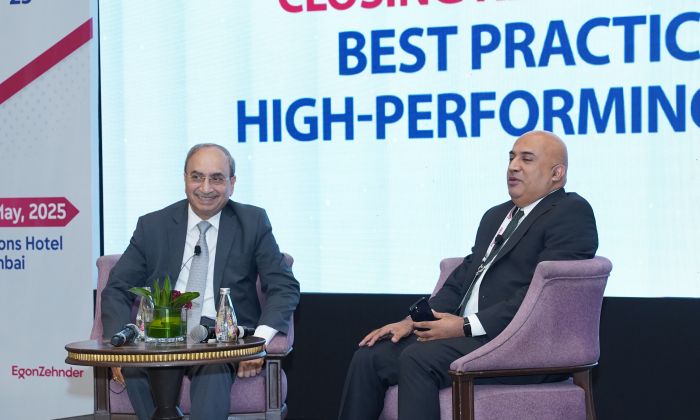
At Egon Zehnder’s Directors Development Program, in a keynote session that combined clarity, candor, and practical insight, Dinesh Khara, former Chairman and Managing Director of the State Bank of India (SBI), shared his reflections on what makes a board not just functional, but high performing. Drawing from his leadership experience across banking, insurance, asset management, and fintech, Khara illuminated the nuances that distinguish effective boards – from the structure and role of committees to the behavioral patterns of board members and chairs.
As financial institutions face increasing complexity and regulatory intensity, Khara’s central message was simple but powerful: great boards are those that combine compliance with curiosity, structure with flexibility, and oversight with strategy.
Grounding the Board in Reality: Customer-Centricity and Context
Grounding the Board in Reality: Customer-Centricity and Context
At the heart of effective board work, Khara emphasized, is a deep understanding of the operating environment, especially in the financial sector, where fiduciary responsibility is paramount. “Financial sector is something which is witnessing quite a lot of ecosystem changes. And at the same time, this is one sector which is very tightly regulated too and rightly so, because they deal with the savings of others, and it's more of a fiduciary responsibility, which they have to carry out.”
In this context, board members must stay connected to both the regulatory perimeter and the expectations of customers. Khara advocated for a shift from traditional customer service to a more nuanced view of customer experience. This, he explained, has implications not only for strategy but also for how products, processes, and technology are designed – always with the end user in mind.
Policy, Practice, and Regulatory Integrity
Policy, Practice, and Regulatory Integrity
Policy formulation, a core board responsibility, cannot be treated as a theoretical exercise. Khara cautioned against disconnecting board decisions from operational realities: “Policy making, unless and until there is a connect with the practice, the policies may not be really meaningful.
This emphasis on trust – regulatory, stakeholder, and public – was a recurring theme throughout his address. Compliance, he added, must be pursued both in letter and in spirit: “It may so happen that the policy may ensure compliance in terms of the letter, but not in terms of spirit. Regulatory trust is also very, very important in this particular context.”
Inside-Out and Outside-In: The Role of Independent Directors
Inside-Out and Outside-In: The Role of Independent Directors
Turning to board composition, Khara highlighted the unique value that independent directors bring, particularly their ability to offer external perspective. “What is expected from the independent director is more in terms of the interplay of how they are seeing things from outside. So actually, it's a combination of both outside-in approach versus inside-out approach.”
He recounted how, during his tenure at SBI, regulatory guidelines from the 1950s required board representation from sectors like agriculture and SMEs. However, to future-proof the bank, Khara prioritized expertise in technology, cybersecurity, and digital transformation, areas not always addressed by traditional nomination processes.
When formal appointments fell short of this need, SBI created advisory committees populated with domain experts: “We came out with an advisory committee wherein we brought in people from the cyber, we brought in people from the digital, we brought in people from the hardware side.”
These experts regularly engaged with board-level committees, ensuring the bank had access to cutting-edge insights, even if such expertise could not be formally embedded on the board itself.
Embedding Strategic Thinking and Effectiveness Through Structure
Embedding Strategic Thinking and Effectiveness Through Structure
As financial boards become increasingly burdened by compliance and regulatory reviews, Khara advocated for intelligent delegation through committees: “The Compliance Review Committee, which is a board level committee, was constituted, and through that it will come to the board.”
This structure allowed the board to remain focused on forward-looking strategic questions, while still maintaining oversight over regulatory matters: “The time is limited for board members. So, it is for the board to really deliberate more in terms of strategy and to see how the entity can remain relevant for the segment whom they serve.”
Committees were designed with care: whole-time directors led specific areas, and independent directors with domain interest were selected for relevant roles. The result, he said, was deeper engagement and better preparation: “It actually gives an opportunity for the board members to also interact with the larger team and develop their own confidence in terms of compliance standards.”
Board effectiveness, in Khara’s view, is inseparable from the time directors are willing to invest. “The board director role in State Bank of India is a very heavy role. Some people have said that they are not interested to come on the board because it is almost like a full time job.”
The Role of the Chair: Listening, Balancing, Leading
The Role of the Chair: Listening, Balancing, Leading
No board can function well without a competent and committed Chair. For Khara, an ideal Chair is one who leads with both vision and humility: “He should also have, I would say, a strong level of knowledge about the industry… and again, he should be in a position to have his hands on the nuts and bolts, if need be.”
Effective Chairs, he said, listen more than they speak, and distinguish between noise and insight: “There is a need to listen to the viewpoint of the members… his ability to really grasp it fast and differentiate what is the noise and what is the crux.”
Chairs must also understand the individual strengths of directors, ensuring everyone contributes meaningfully. When some members dominate, the Chair’s role is to allow space without ceding influence: “Those who seek to dominate and show off may be given ample opportunity to do so, but ultimately, the decision should remain uninfluenced by their display of dominance.”
Modeling Board Behavior and Asking the Right Questions
Modeling Board Behavior and Asking the Right Questions
Reflecting on his own behavior as Executive Chair, Khara explained how he deliberately positioned himself as the first to challenge management proposals, not to undermine them, but to set the tone for rigorous scrutiny: “The first person to raise questions used to be the chair. Opening batsman used to be the chair. That ensured that the risk should be properly dealt with by the executives on ground.”
This created a culture where other directors felt empowered to question and contribute, and where even complex or contentious proposals could be deferred for further diligence without stigma: “It happens once in a while. And I would say that whenever it happened, it happened for good.”
Asked to describe board members who stood out, Khara was unequivocal: “Of course, because they used to be thorough with the agenda. They used to have a complete understanding of the agenda. And also, when they were talking, they were talking out of their experience, which brought lot of value on the table.”
Their insights integrated market realities, sector trends, and personal expertise. Equally, he cautioned against performative participation: “At times, some board members got a tendency to showcase their presence… that is something that is welcome, if they have a contribution. If not, then probably they should stay away from such behaviour.”
Substance, he reminded the audience, always outweighs form.
A Final Reflection: Integration Builds Trust
A Final Reflection: Integration Builds Trust
Closing the session, Khara offered one final piece of advice. Integration between new board members and the enterprise is not optional; it is essential. And it should begin with structured, intentional onboarding: “Each and every vertical should come and make a presentation, explain in detail what they are doing, how they are doing, what are their risks, what are their challenges and how they are managing all those things.”
This practice, he concluded, not only equips directors with critical context but also fosters trust between board and management, enabling more informed and effective governance.
