


In just a few short years, it’s become clear that generative artificial intelligence (AI) will play a significant role in shaping the future of the banking, financial services and insurance (BFSI) sectors. What may not be so clear, however, is exactly what widespread AI adoption will look like in terms of specific solutions and their implementation, and what banking and insurance leaders can do to better navigate this increasingly competitive digital landscape and maximize ROI over the long term.
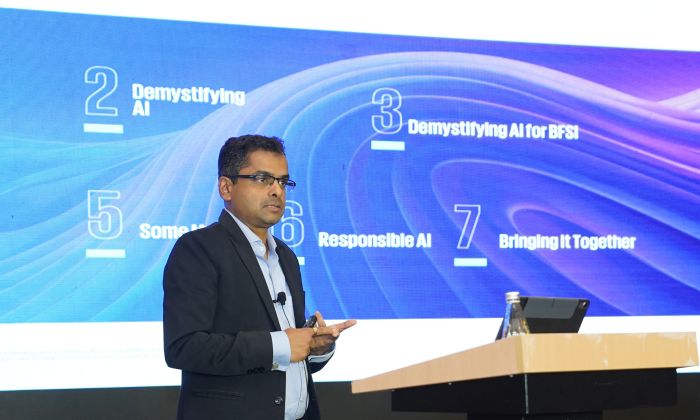
As part of Egon Zehnder’s Directors Development Program, a session on the topic was led by Purushothaman KG (Puru), Head of Tech Transformation for KPMG India and career technology expert with cross-functional expertise in AI and intelligent automation. Throughout his presentation, Puru shared what he believes to be the most critical factors to consider when implementing an AI strategy, highlighting the importance of targeting capabilities based on existing infrastructure and operating models, as well as a variety of current and emerging use cases and operational challenges. Here are just a few key takeaways from the session:
Identifying Opportunities, Strategies and Archetypes
Identifying Opportunities, Strategies and Archetypes
As excitement around AI continues to intensify across the BFSI landscape, many banks and insurance companies may find themselves rushing toward integration in the fear of being left behind. However, as Puru pointed out, while it’s appropriate for organizations to be ambitious and to acknowledge the pervasive sense of urgency surrounding these initiatives, some may run the risk of optimizing for speed at the expense of strategy.
“Every organization I talk to has an ambition, but not all have asked the question do I want to be a first mover or a fast mover,” he said. “Both are equally important if you’re looking to create something very unique to your industry and domain.”
In addition to narrowing their focus toward a specific domain, Puru highlighted the need for organizations to acquire a deeper understanding of what AI is and how it can be deployed in a variety of contexts. More specifically, whereas knowledge around AI tools and capabilities is frequently limited to text-based large language models like ChatGPT, the reality is AI represents an increasingly wide range of technologies and use cases, each of which fit into a different archetype based on the industry and objective. And integrating any one solution successfully requires first identifying the relevant archetype and defining what it is you’re trying to accomplish.
“AI models being deployed at the enterprise level are not as simple as just querying and receiving an answer,” he said. “So, it’s very important to determine what it is you want to create and how you’re going to use it. Is it going to be a virtual call center agent or chat bot on your web and mobile application? Are you looking to generate content or extract information from existing documents? Is it going to be a language translator? There are different archetypes depending on these simplified use cases, and this is how I would look at it when deploying an enterprise solution.”
Additionally, Puru stressed that banks and insurance companies must keep in mind that AI should not be viewed as something to build and operate independently of existing products and operating models. And this is because deploying a solution outside of your existing infrastructure and tech stack is not only costly but also won’t eliminate the need to optimize your core offerings and digital ecosystem as they are.
“Organizations need to think about how they’re driving important KPIs, such as time to market, experience, and growth, because this is not going to change whether you have AI or not,” he said. “So, what we’re seeing and debating today is how can AI be embedded into what I’m already doing rather than creating a new work stream and trying to drive it independently of my original digital initiatives.”
Existing and Emerging Use Cases
Existing and Emerging Use Cases
Moving beyond AI archetypes to more specific use cases and objectives, Puru had a depth of knowledge to share about how and why these tools are being used across the banking and insurance sectors. To make a distinction between existing and emerging applications, he provided examples from both the public domain and his personal and professional experiences.
Uses in the public domain today, as Puru noted, reflect the shared goal of BFSI organizations of creating and adding new value to both customer-facing and internal processes. For example, banks in the early stages of adoption have become increasingly open about their utilization of AI to enhance rather than replace key aspects of their operations.
“Banks today are looking for tools accelerators to improve what they already do,” he said. “They’re looking to optimize market research, risk identification, fraud monitoring and so on. And these are all things banks are transparently working on from a public domain perspective.”
Of course, marginal improvement of existing operations is merely the baseline of what AI can offer both banks and insurance companies, whereas the truly revolutionary potential can be more readily found in private and emerging use cases, which tend to more prominently feature intelligent automation and machine learning models. “Beyond the public domain, I’m personally seeing BFSI organizations use AI toward more ambitious and potentially transformative objectives,” said Puru. “These include improved credit scoring to support lending practices, customer experience innovation, account opening and onboarding, and other critical areas where customer due diligence and analysis is critical. Insurance companies today have even begun using AI to more efficiently respond to customer queries and complaints.”
Critically, Puru also pointed out that smart, strategic implementation of AI doesn’t need to be limited to a specific product, function, or department. In fact, he has seen first-hand how one bank was able to create a highly intuitive and flexible architecture to be shared and embedded across the entire organization, which resulted in a wider and more diverse distribution of models and impacts, and most importantly the establishment of an internal culture of AI-powered innovation.
“What is critical here is they created a simple orchestration for different AI models to be embedded and made it available to their branches and subsidiaries all over the world,” he said. “And it was created as a low code platform to make it easier for employees to innovate and create new use cases. Once that’s built for one department and function, it creates a chargeback mechanism for other employees to use in their own context and respective function.”
Understanding and Reacting to Practical Challenges
Understanding and Reacting to Practical Challenges
Despite the rapidly broadening adoption of AI across the BFSI landscape, Puru was careful to highlight the need for organizations to acknowledge that we are still in the early stages of implementation, and they should be anticipating and planning around several persistent practical challenges.
For one, Puru reiterated his advice of building AI solutions on top, as opposed to apart from existing infrastructure. More specifically, whether you’re building an AI-powered compliance reporting bot or claims processor, overcomplicating the process or bringing too many players on board can create unnecessary operational challenges and drive up the cost of implementation.
“When you evaluate the use cases for your own respective banks, you need to actually look at how do I build something that I only build once, but that I use for different cases,” he said. “This is why I advise companies not to reinvent the wheel. You don’t need to bring in various external partners when you already have an existing infrastructure. Instead, try to make the most of what you have, because rebuilding the entire system and then building use cases on top of that is very difficult.”
Finally, one particularly significant and potentially long-term challenge facing BFSI leaders today is the creation and enforcement of responsible AI frameworks. This could prove to be a difficult task for many organizations, not only because laws around the use of AI for banks and insurance companies have yet to be implemented in an official capacity, but because separate tools being deployed will often require separate frameworks.
“Responsible AI means creating models that follow fairness and explainability, among other principles, and each platform being used will need to address these in one way or another,” said Puru. “So, as a board member, if your team is planning to integrate any emerging models going forward, you’ll need to ensure that a responsible AI framework has been implemented in correspondence with all relevant privacy and IT policies.”
