


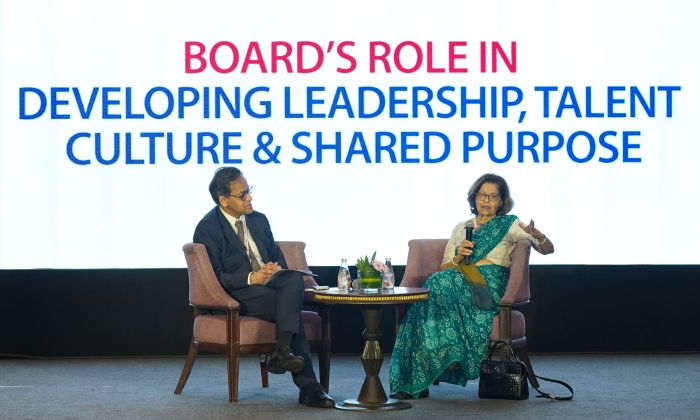
As expectations of corporate boards continue to evolve, their role in shaping the intangible elements of organizational success – such as leadership development, culture, and shared purpose – has become central. A recent session of the Directors Development Program hosted by Egon Zehnder, featured Kalpana Morparia, former chairperson, J.P. Morgan, South & Southeast Asia, in conversation with Darpan Kalra, Partner at Egon Zehnder, where she shared hard-earned insights with the participants from decades of leadership, both in executive roles and on global boards. Her message was clear: beyond strategy and compliance, boards must actively engage with people, purpose, and values.
Purpose Before Performance
Purpose Before Performance
Kalpana began by situating purpose and culture at the core of long-term value creation:
“If I had to choose one area where I believe the board can make a truly phenomenal impact, it would be in shaping the company’s purpose and culture”.
She reflected on her experience across numerous boards, noting that only a few treat culture as a “core agenda item.” Still, she cited examples where small but consistent board-level practices – such as having independent directors or senior executives share reflections on cultural movements – yield meaningful insights: “Whilst that’s just 5 minutes, I think it enables the board to get a sense of what’s really working well and what needs some work on.”
Kalpana also drew a powerful connection between purpose and employee engagement, especially among younger generations: “If you do not identify with the purpose of the company, you’re always going to be on the lookout for doing something different.”
Engaging with Talent: Practices and Pitfalls
Engaging with Talent: Practices and Pitfalls
Delving into talent engagement, Kalpana outlined practices she has seen work well. A key one: full-board reviews of internal talent pipelines, with candid, forward-looking assessments. “There is a very good assessment in terms of are they ready now for the next role? Ready two years later, what are the leadership interventions that we need in terms of ensuring that they move up the ladder?”
This practice, she noted, needs to be refreshed regularly to remain relevant. She also highlighted a method used during board meetings, where directors meet with employees they don’t normally interact with: “What one of my boards does – I would say it overdoes it sometimes a bit – is ensure that the time that we would have during the committee meetings which are taking place, where we are not a member, we get to meet skip level people.”
These interactions are not limited to senior talent. Directors are encouraged to meet members of employee resource groups, customers, and even vendors, offering broader exposure to the organization’s ecosystem. In discussing succession, Kalpana described what she called “truly the best practice that I’ve seen in CXO succession”, where the board starts succession planning at the time of a CEO’s appointment – not their departure. “It was a regular exercise that the full board engaged in at least twice a year. And there were very comprehensive assessment exercises in respect of the internal talent which the board had complete transparency to.”
The Power of Feedback and Role Awareness
The Power of Feedback and Role Awareness
Kalpana spoke candidly about the personal transition from executive to independent director – and the challenge of recognizing the limits of the role. “It’s only when you actually get on to a board to be an Independent Director that you quickly realise that it’s not your job to go and execute what you’re preaching at the board.”
A turning point came early in her independent directorship, when an external board review held up a mirror to her behaviors: “They told me, Kalpana, you’re no longer the Executive Director of ICICI. You are an Independent Director on this board. So constantly harking and saying this is what we used to do is not relevant.” The experience reinforced her belief in the value of honest feedback: “Each one of us has a certain opinion about ourselves, but that’s not the way the others are perceiving you.”
Kalpana encouraged all directors to embrace board reviews, external ones in particular, not only for board effectiveness, but also for individual development: “I see the greatest value in the individual feedback that we get.”
Culture in the Boardroom and the Organization
Culture in the Boardroom and the Organization
Turning to culture, Kalpana underscored the board’s responsibility to ensure ethical integrity, especially in sectors like banking: “One of the top culture issues for us is ethics and compliance. We cannot do without technology. We cannot do without innovation. We absolutely need that to be at the cutting edge of our businesses. But for us ethics and compliance are absolutely important.”
She shared practical approaches for embedding culture into board routines. One effective method: “Just as you have a CEO report and a CFO report, in every meeting of yours, there is also a CHRO report.” Another practice involved equipping senior management with tools for inclusive decision-making: “Do we also need to give them some tools? In terms of how do you debate and discuss a key decision… and ensure that the diversity of views across the room are all debated and discussed before you actually come to a decision rather than the CEO thumping the table.”
Reflections on Public Sector Contexts
Reflections on Public Sector Contexts
Kalpana acknowledged the constraints in public sector banking, such as the limited role boards can play in top-level appointments. Still, she emphasized that directors can influence broader talent development: “You will be able to spot people who are curious. And at that time, if you actually zero in on that person or several individuals and give them more and more challenging assignments, you’ve done a great job in yourself.”
She illustrated this with a personal anecdote: “This person was actually from the Global Capability Centre. I persuaded his boss to say, rather than doing the Global Capability Centre role, can you send him to me? And I’d like him to be part of my business management team. And the guy is a Managing Director today in London and doing phenomenally.”
Managing the Compliance Burden
Managing the Compliance Burden
In response to questions about the heavy compliance load in board meetings, Kalpana offered structural solutions: “Each one of us took a primary responsibility. I took up the responsibility for engaging more on the internal audit stuff.” She also recommended holding additional Audit Committee meetings outside of quarterly reviews: “So the big ticket items get fully fleshed out there, and therefore in your quarterly meetings, greater focus is really on the financial performance.”
Moreover, she advocated full transparency of committee materials: “All members of the board must have access to all committee papers… even if you are not on those committees, to actually review those papers.”
Closing Counsel
Closing Counsel
As the session drew to a close, Kalpana offered grounded and practical advice to those currently serving—or aspiring to serve—as independent directors. She emphasized the importance of developing a deep understanding of the business beyond the boardroom, and of staying connected to the organization at all levels: “Get to know the core business. I find it also very useful to meet the people in the trenches.”
Equally vital, she noted, is the ability to maintain perspective and boundaries, particularly for those transitioning from executive roles to governance positions. Independent directors must not blur roles or hesitate to offer honest perspectives: “Constantly remind yourself that you’re not the executive, you are the Independent Director and be very candid with your feedback on your peers.”
Kalpana also called for a reimagining of the Nomination and Remuneration Committees (NRCs), suggesting they move beyond compensation oversight to truly embrace their broader people mandate: “Just as the Audit Committee is tasked with the integrity of the financial statement, I think it’s important for NRCs to enhance their scope. And truly make it a People’s Committee.”
She concluded with a powerful reminder that purpose and culture are living elements of an organization. They should not only reflect current realities but also anticipate future generations of leadership and their evolving values. With characteristic clarity, she urged directors to remain open to generational insight: “We can allow ourselves to use that youngster mindset to find out what Shared Purpose and Culture should be 20 years from now.”
