


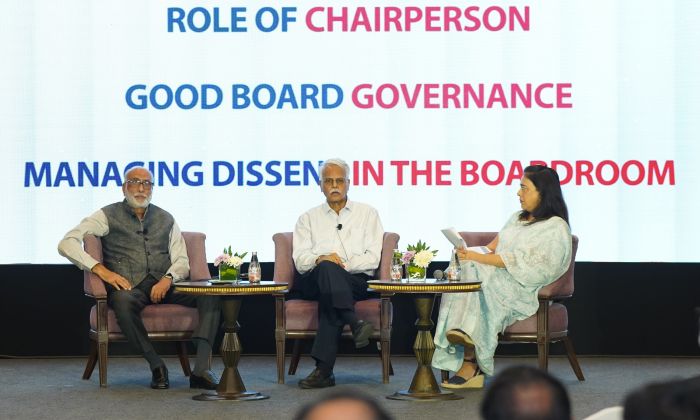
Is the role of a board Chairperson to be a powerful company figure sitting at the head of the table, or something more nuanced and collaborative? That was the subject of a panel discussion at a recent session of Egon Zehnder’s Directors Development Program featuring S.S. Mundra, former deputy governor of the Reserve Bank of India, and Deepak Satwalekar, former Managing Director, HDFC Limited.
In the session, moderated by Namrita Jhangiani, Partner at Egon Zehnder, the two experienced board and business leaders spoke on what they saw as the most important responsibilities for board Chairs, including how to manage dissent and foster collaboration across directors.
The Chair Should Be ‘First Among Equals’
The Chair Should Be ‘First Among Equals’
Mundra and Satwalekar agreed that rather than assuming an authoritative, managerial role on the board, Chairs should instead see themselves as “first among equals.” This means setting and distributing the agenda and working as a communications channel between the CEO and the board. But it also means mentoring other board members and helping them contribute just as much insight as a Chair might.
“I think the Chairman must be a facilitator,” said Satwalekar. “Because if you have a board that is comprised of equals, how do you get the best out of them? That’s why you need to be a facilitator, because in any board what you will find is there will be some people who will take the mic and start speaking, no matter what the subject being discussed…and then there are others who may be equally or even more knowledgeable, but who are averse to speaking up, so they will not speak. I think the bigger role for the Chairman is to ensure that he gets the best out of every board member on the relevant topics with the person who has the relevant experience.”
Part of being able to accomplish this is a Chair making themselves accessible to other board members, both inside and outside the boardroom. “The Chairman must be able to build up a relationship with each board member so that he knows the strengths and weaknesses of each person,” said Satwalekar. “And once he has that knowledge, the board members also build up confidence in the Chairman.”
A Chair should also know their limits and find opportunities to delegate responsibilities to other members or board committees. “We all know that a lot of work, the real work in any board, is executed through the committees,” said Mundra. “It’s not possible for the board to handle everything. Committees do it and then the distilled outcome comes to the board.”
But doing so again requires the Chair be familiar with the other members, and aware of their strengths and weaknesses.
“I think as a Chairman it’s very important how you decide the constitution of committees, and how you decide who will be the Chair of each committee,” said Mundra. “This is possible only when you know about the traits of individual directors and then put the best talent to use in the most appropriate place.”
All of this, in the end, will build a better functioning board with more effective members. “My definition of a successful leader is someone who creates more leaders,” said Satwalekar.
Collaborate, Don’t Compete
Collaborate, Don’t Compete
As for interactions with company management, board Chairs should avoid micro-managing staff. Mundra said that a board Chair with a background as an executive can aid this by making it easier for them to understand the perspectives of management and the CEO, whose responsibilities are much more intertwined with a firm’s day-to-day operations.
“It is the Chair’s right to ask questions, it is the Chair’s right to seek the information, but individually, it is not for you to direct the management,” said Mundra. “Your role is to look at the strategic issues, not get into micro-management.” Both Mundra and Satwalekar emphasized that as part of this, board Chairs should shed any sense of ego and, again, see themselves as simply the first among equals.
“The Chair should be very comfortable in their skin,” said Mundra. “I mean to say that you have done whatever is to be done, you have seen it all, you are happy with where you have reached. So, you are not in competition with the CEO, you are collaborative. You have a good chemistry.
Similarly, Satwalekar said that Chairs should have the self-confidence and assuredness to understand that they don’t need to be in complete control:
“The Chair doesn’t have to prove every day that he is superior. His superiority will be proven by the success of the functioning of the board and by the success of the chief executive.”
Managing Disagreement and Dissent as a Chair
Managing Disagreement and Dissent as a Chair
Board members will not always agree on everything. Such disagreement can be healthy, and spur productive discussions about the long-term vision and goals of a company. And as the first among equals, board Chairs have a responsibility to shepherd that discussion, mediate debates, and find common ground.
But sometimes, disagreement crosses into dissent, or an unmanageable conflict with no reasonable solution. “Dissent is an extremely strong term,” said Satwalekar. “I think if you have to manage dissent in a board, the Chairman has failed. It should never reach the level of dissent.”
Mundra warned that such intractable dissent may be the result of “hidden agendas” among members. “Most board members are well-meaning, but there are occasions that you will find certain individuals who go for dissent,” he said. “I may say that at times there could be a hidden agenda. It’s not something very uncommon.”
In either scenario—disagreement or full-on dissent—keeping open communication channels between the Chair and members is key to understanding the reasoning behind the conflicts. And if consensus can’t be reached in the boardroom, conversations can move outside for potentially more candid and frank talks.
Going further, Chairs can postpone the meeting or adjourn it to better prepare or give the dissenters due consideration. “Ultimately, my personal experience is at the end of the day, a well thought out consensus emerges, and at times those differing viewpoints bring certain valuable input in the overall thing that you are trying to do,” said Mundra.
Giving Feedback Leads to Good Governance
Giving Feedback Leads to Good Governance
Even among equals, it’s still good practice for Chairs to give feedback to other board members on their performance. Doing so can ensure effectiveness across all members and functions, while laying a cornerstone for good corporate governance.
These evaluation sessions normally come yearly, and some companies may engage external firms to help with the process by playing the role of the neutral observer. “I think I’m now a convert to external assessments because they can ask questions and the independent directors can also feel comfortable talking to someone who’s not within the company itself,” said Satwalekar.
Of course, feedback can be either negative or positive, and it’s important for a Chair to think about how they will deliver compliments versus how they will deliver reprimands.
“My principle has been to give praise in public and give negative feedback in private,” advised Satwalekar. “So, if there is any corrective action that I would like one of the directors to take, then I will do it in a one-on-one with that person separately. But if there are compliments to be given, I’d rather everybody hears it.”
If there is negative feedback that must be issued, Chairs must remember to not let their ego drive the conversation. “It’s not about one-upmanship,” said Satwalekar. “You’re just telling them why you think what you’re saying is important. We are on the same team. I think once they believe that you are doing this out of no other motive but the interest of the company, you’ve won more than half the battle.”
