



The Call to Action
The Call to Action
“How do we keep our best talent engaged and growing as our fund grows?”
“As we grow, is my next Partner promoted internally, or found externally?”
“‘I know it when I see it’ just isn’t cutting it anymore for promotions: How do I know when a Director is ready for MD, and MD is ready for Partner?”
“Why does my job as a Partner feel harder?”
“How do I ensure my firm becomes an enduring, multi-generational franchise?”
These are questions we hear every day from private investment firm leaders. The answers point to a surprising truth: The most overlooked investment opportunity isn’t a new sector or strategy; it’s your people.
LPs Care About Talent and Succession
LPs Care About Talent and Succession
Limited Partners (LPs) are increasingly focused on governance and continuity. A recent survey by law firm Barnes & Thornburg found that 96% of LPs believe succession planning is critical, yet only 38% of GPs have a formal plan.

Source: Succession Planning: LP Expectations vs GP Reality. Barnes & Thornburg, August 2024.
One LP put it bluntly: “If you can’t show me who’s next in line, why should I trust you with my capital for the next decade?”
Succession planning isn’t just risk mitigation but a signal. When GPs role-model strong talent practices, LPs translate the same rigor applying at the portfolio level. In a competitive fundraising environment, this can be a powerful differentiator. Not to mention the myriad of benefits strong talent development practices in the portfolio brings.
And there are big benefits internally, as the best talent wants to work for firms where career paths are clear and real. But the implications extend far beyond LP perception.
First, the best talent in the market wants to join firms where there is a real path to Partner/GP. Clear progression and visible opportunities are powerful signals for high performers who are choosing where to build their careers.
Second, relying on lateral senior hires is costly and risky. When firms can’t develop leaders internally and need to bring in Partners from the outside, the complexity increases dramatically: alignment, culture, operating style, expectations. Leaders who grow up inside the firm naturally carry fewer integration risks.
And third, strong internal talent practices lift performance. When mid-level investors are well developed and supported, they show up as stronger board partners, better collaborators with management teams, and more confident leaders during pressure moments.
The Best Investors Don’t Always Make the Best Leaders
The Best Investors Don’t Always Make the Best Leaders
Promotions often reward past performance, not future potential. In private capital, the skills that make someone a brilliant dealmaker do not automatically make them an effective leader, portfolio company board director, or fundraiser.
As one senior partner admitted: “We promoted our best investor to managing partner—which then showcased his blind spots as a people leader.”
Best-in-class firms codify role expectations from analyst to managing partner, covering deal execution, portfolio management, leadership, and firm-building. This “what good looks like” clarity across key areas of the private capital role (e.g., origination, deal execution, firm building) drives better promotion decisions, enables targeted development, and signals commitment to talent, boosting retention and morale.
Your Mid-Level Talent Is Narrow and Getting Stuck
Your Mid-Level Talent Is Narrow and Getting Stuck
As funds scale, they often become top-heavy. Partners handle origination, leaving mid-level professionals siloed and underexposed. Many mid-tenured investment professionals report feeling “stuck,” with limited scope, unable to stretch, and unclear on their path forward.
One VP shared: “I’ve been here six years, but I feel like an associate with a bigger title.”
This stagnation has consequences: retention risk, underdeveloped leadership skills, and a pipeline clogged with talent that isn’t ready for senior roles. Without intervention, firms risk losing their future leaders or promoting individuals who aren’t prepared. Few firms invest in giving their mid-level talent enough rounding opportunities, for example working on deals in different sectors, secondments at portfolio companies, or skill training for areas that require growth. An important insight from the mid-level perspective is that, even if titles can’t expand due to fund size or firm structure, your firm must ensure enough opportunities for skill growth.
The ROI on Talent Development
The ROI on Talent Development
Private equity has historically embraced a “survival of the fittest” mindset. But the costs of underdeveloped talent are real and increasingly hard to ignore. When partners spend time fixing people issues instead of sourcing deals or fundraising, everyone “plays down,” and core value-creation work gets deprioritized. Top junior talent also becomes far more at‑risk, as they don’t want to be managed by ineffective Directors/MDs, and the best performers have options elsewhere leaving the most critical items for the firm deprioritized. And across the portfolio, value erodes when MDs struggle to navigate leadership challenges without targeted feedback or development, slowing their progression and creating avoidable execution risks.
Investing in leadership development, especially for mid-level professionals, pays off in retention, performance, and partner leverage. Training on board influence, team leadership, and people development equips investors for the realities of senior roles.
As one managing partner put it: “Every hour I spend working to fix something with my VP is an hour I’m not on the phone scanning for opportunities or thinking about our next fundraise. Development isn’t a luxury—it’s leverage.”
A Practical Framework for What “Good” Looks Like in PE Leadership
A Practical Framework for What “Good” Looks Like in PE Leadership
For firms wondering what exactly to develop in mid‑level and senior talent, we use a five‑competency framework built specifically for investors. It lays out the key capabilities that matter at each stage of development and gives teams a shared way to talk about readiness and growth.
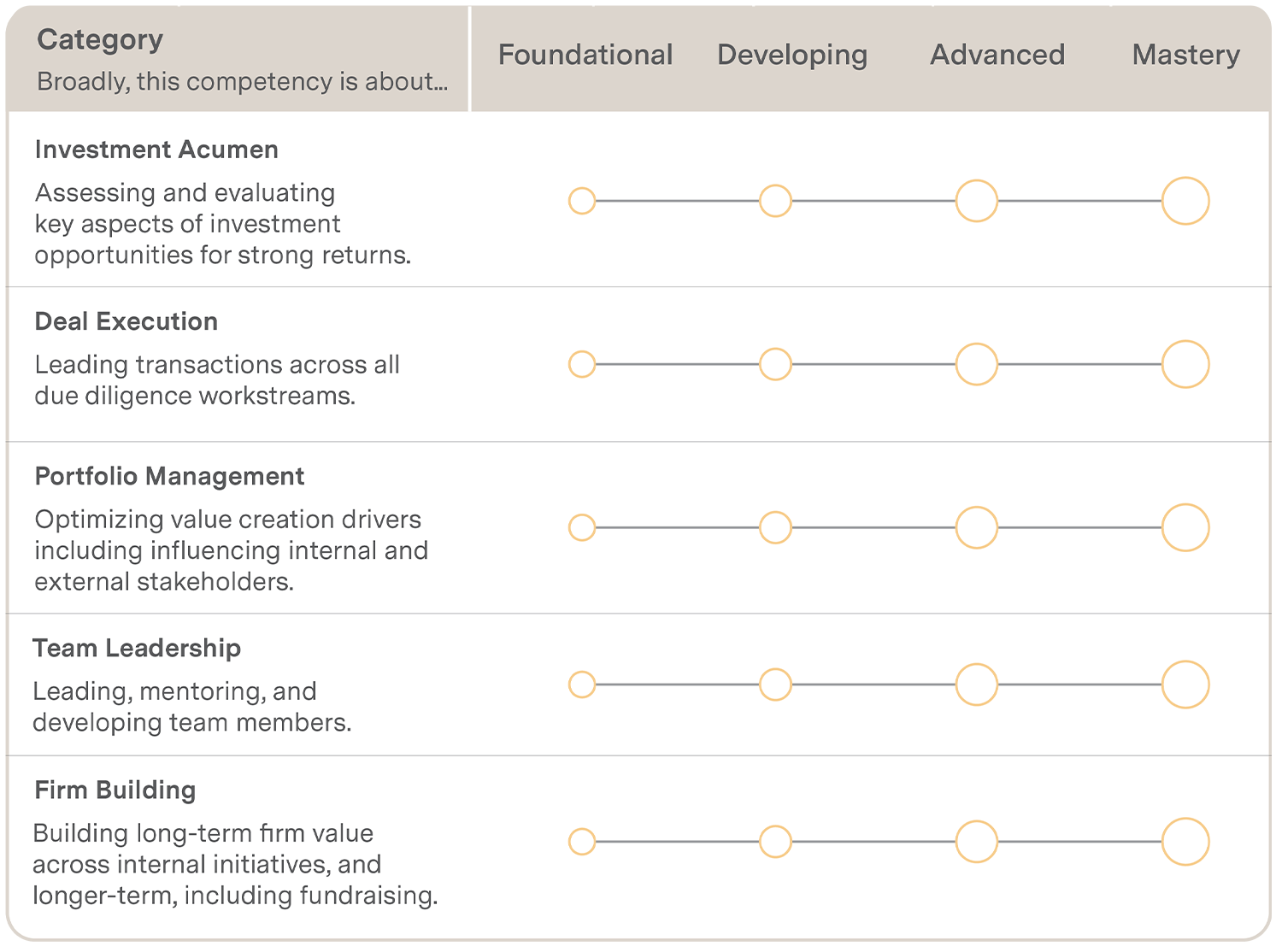

Each competency has a clear progression, from foundational to mastery, so firms can pinpoint where individuals excel, where they’re bottlenecked, and where development will have the greatest impact. It also allows firms to measure progress over time and link it directly to performance outcomes.
This is where the real differentiation happens: when firms can objectively assess their talent and intentionally move the needle on the behaviors that drive results.
Conclusion
Conclusion
The best investment private equity firms can make isn’t in a new deal; it’s in their people. LPs care. Succession matters. Mid-level talent needs – and wants! – development. And the ROI is undeniable.
At Egon Zehnder, we’ve partnered with leading funds to design succession plans, clarify role expectations, and build leadership capabilities that drive performance. If you’re ready to turn talent into your competitive edge, let’s start the conversation.
