


To more effectively navigate today’s rapidly evolving business and compliance landscape, many corporate boards across the banking and insurance sectors are in the process of rethinking their approach to corporate governance. From the integration of advanced technologies into payments and claims processes to emerging regulations around data privacy, we have clearly entered a new frontier in which board leaders must thread an increasingly thinner needle between prioritizing competitive innovation and meeting a variety of strict and constantly shifting regulatory obligations.
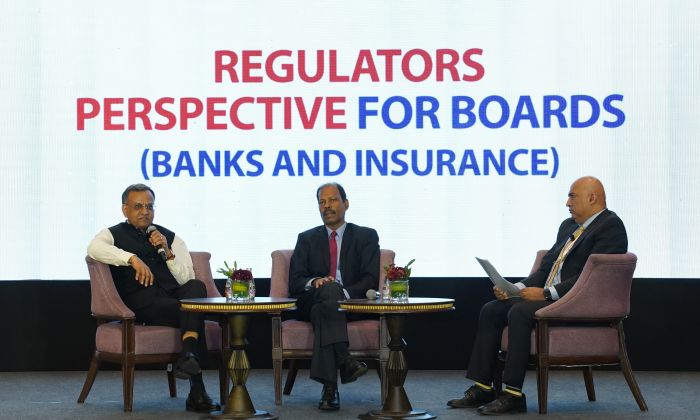
But what would an ideal board look like in such an environment, and how can banking and insurance companies stay focused on optimizing growth without losing sight of or falling behind on compliance? As part of Egon Zehnder’s Directors Development Program, one of the sessions included a panel discussion with Subhash Khuntia and M K Jain, two former regulators with experience holding key oversight positions at the IRDAI and RBI. Here are several key insights and takeaways from the conversation moderated by Vineet Hemrajani, Managing Partner at Egon Zehnder India.
Optimizing Direction, Control, and Independence
Optimizing Direction, Control, and Independence
Before you can even begin to imagine an ideal boardroom amid a culture of change, Khuntia reminds us that there first must be an acknowledgment of the basic roles and responsibilities of the board of directors, namely the core principles of direction and control. “Direction refers to setting a strategy for sustainable growth, while also ensuring the interests of the stakeholders are protected, particularly in banking and insurance,” he said. “Then, as far as control is concerned, it’s basically oversight, supervision, and compliance with the acts, rules, regulations, and even policies set forth periodically by the board.”
While this might sound straightforward, boards aren’t always composed with the optimization of these two principles in mind, and Khuntia stressed the growing need for diversity of perspectives when appointing these positions, and to ensure there is sufficient knowledge and expertise to address both sides of the equation. “The ideal board will have directors brought in from various disciplines, and they should have expertise in all facets of the company, as well as the reputation and unwavering commitment required for the job.”
However, although establishing and maintaining direction and control are prerequisites to the composition of any effective board, both speakers agreed that neither are possible in the absence of total independence. “It’s important that the board runs smoothly and incorporates the right combination of skills and knowledge, but at the same time it must have independence of the shareholders and management, because the board’s very function is to act independently in the best interest of the company,” said Khuntia.
Making Time for Strategy and Compliance
Making Time for Strategy and Compliance
As anyone who has served on a board of directors will tell you, time is always considered an invaluable commodity, and using the limited amount effectively is paramount for success. This is particularly true today as demands around both business strategy and regulatory compliance become increasingly complex.
In addition to the Chair upholding their responsibility to ensure meetings are conducted transparently, independently, and democratically, Jain explained the importance of how agenda papers are prepared ahead of sessions, and why it’s critical for board leaders to more frequently question the relevancy of proposals to establish trust with management and make the best use of the board’s time. “Quite often, I’ve seen agenda papers that are too bulky,” he said. “The contents should be crisp. It should be appropriate, relevant information, because if it’s too loaded it will cause us to lose our focus.”
These comments opened a broader discussion about what boards can do to ensure meetings are productive, and how they can plan to make sure all aspects of the business are given equal time and attention. More specifically, Khuntia shared two possible strategies related to both scheduling and the composition of agendas.
“One answer is to devote separate sessions for compliance related matters and innovative, strategic decisions related to business strategy,” he said. “And another approach I’ve found useful is to conduct one annual meeting at the beginning of the first quarter, in which the whole day is dedicated to discussing all important items and planning how additional meetings will be conducted for the entire year.”
Additionally, Jain spoke to the fact that board directors often confuse perception with reality when it comes how much time is adequate for a particular item or subject, especially when it comes to compliance. While regulatory matters can frequently feel like they’re taking up too much time, there are many cases in which the opposite is true, and this could be the result of unclear communication on the growing importance of compliance in relation to profitability and cost.
“I used to observe a lot that compliance was not given its due importance, because the perception was that the cost of non-compliance would be lower than the cost of compliance,” said Jain. “But when there’s an understanding that the non-compliance cost is actually higher than the compliance cost, then there’s a real incentive to focus more on these issues as part of the businesses, and this is how we ended up approaching it at RBI.”
Addressing the Risks and Benefits of Emerging Technology
Addressing the Risks and Benefits of Emerging Technology
Finally, Khuntia and Jain both shared their thoughts and advice on perhaps the most urgent challenge facing banking and insurance boards today: how to take full advantage of rapid breakthroughs in artificial intelligence (AI) and other emergent technologies, while also understanding and effectively managing the associated risks.
In terms of risk management, Khuntia stressed the board’s responsibility to devote increasing time and attention to addressing the complex cybersecurity implications of AI integration, which in many cases will need to include seeking the advice of third-party experts if the board itself doesn’t have adequate knowledge and experience.
“With AI, it’s become extremely important that the board devotes enough time to IT security issues, as well as the safety of customer data,” he said. “Even if it’s true that AI will make our lives easier, it’s also going to make criminals lives even easier, because the kind of things that make cyber-attacks easy to detect, like spelling errors and obviously fake websites, are also going to be rectified by AI on the side of the attacker.”
In addition to proactively mitigating the security risks of AI, both speakers agreed that the urgent need for outside support, as well as in-depth internal training, applies equally to supporting digital transformation on the strategy side. More specifically, Jain highlighted the fact that technology, and even AI-powered tools and applications, have become not only a demand but an expectation among consumers today, many of whom view any non-digital banking or insurance process as an inconvenience. And if boards can’t quickly increase their focus on technology, they risk not only providing inadequate customer experiences but also missing out on an unprecedented opportunity to establish themselves on the forefront of innovation.
“We haven’t done nearly enough to leverage technology and the enormous amounts of data that come with it,” he said. “Tools like AI and machine learning can make a huge difference in the customer experience, as well as optimizing cost and operational efficiency. So, I think it’s high time that board members really insist upon addressing technological strategy, even dedicating separate meetings to the topic whenever possible.”
