



More and more Chief Financial Officers are making a bold and deliberate move.
After building long, successful careers in large, professionally managed organizations, often reporting to non-owner CEOs who operate within clear governance and institutional norms, they are stepping into CFO roles in privately held, owner-led companies. These may still be large, complex businesses, but they often run on a completely different operating logic.
The attraction is clear. The role itself is often broader. Proximity to decisions is higher. Impact can feel more direct. But what is often underestimated in this transition is that it isn’t simply a shift in scope, but in how leadership intrinsically works.
In this article, we unpack how the CFO role tends to shift when moving from a large corporate environment to a CEO-owned company and offer a roadmap outlining how CFOs can navigate the transition humanly and deliberately, setting themselves up for success.
Six Structural Shifts in CFO Responsibilities
Six Structural Shifts in CFO Responsibilities
In corporate environments, CFO responsibilities are shaped largely by systems: governance, processes, decision forums, cadence, and clearly defined roles. In many owner-led environments, however, the CFO role leans more on other factors: relationships, trust, timing, and the ability to align people when power is informal or expectations are sometimes implicit.
These are six key structural shifts in how influence, trust, and decisions may work differently:
1. From alignment to proximity
1. From alignment to proximity
In large corporate environments, alignment happens through structure. Strategy cycles, board discussions, and KPIs create a shared direction over time.
In owner-led businesses, alignment tends to be more proximity-driven. It lives in hallway conversations, access to impromptu meetings, and informal dialogue as much as (or more than) the formal processes.
What this means in practice:
Investing in a relationship cadence (short, frequent touchpoints and fast feedback loops), not only formal alignment mechanisms, becomes a central part of the CFO role.
2. From governance to gravity
2. From governance to gravity
In professionally managed organizations, governance distributes influence. Decisions must travel through boards, committees, and authority is shared across structures.
In owner-led settings, even when governance exists, “owner gravity” can be stronger. The CEO themselves, other owners, family voices, board members, or even trusted advisors may shape outcomes in quiet but meaningful ways.
What this means in practice:
The CFO is not aligning a single leader, but a broader ecosystem. Understanding where influence truly sits, maintaining alignment to the CEO, while avoiding becoming the messenger between factions, is as important as understanding the business itself.
3. From challenging through data to challenging through trust
3. From challenging through data to challenging through trust
In corporate environments, strong analysis always has a seat at the table. Challenge is expected, and well-supported arguments carry weight by themselves.
In owner-led businesses, the dynamic can feel different, especially early on. The insight may be right, but how and when it is delivered often determines whether it is accepted or not.
What this means in practice:
The CFO learns to build the relationship first and then challenges through it. Earning trust and the permission to challenge becomes the gateway to making difficult changes.
4. From meritocracy to loyalty
4. From meritocracy to loyalty
Corporate systems often make talent decisions based on performance and (often multi-year) formal succession processes.
In owner-led businesses, loyalty and history can weigh more heavily on these decisions. Many of the people in the room have been on the journey for years with the CEO. An external or corporate CFO can trigger a subtle “immune response.”
What this means in practice:
Before driving change, the CFO needs to honor and contribute to the story. Change is more readily accepted when it is proposed as a “shift” in a widely accepted long-term plan instead of justified as a step forward to how “best-in-class companies do it”.
5. From speed to weight of decision
5. From speed to weight of decision
In corporate environments, decisions can be slower due to governance or consensus, with more checks and various safety nets along the way.
Decisions in owner-led companies often feel more immediate. They move quickly and with fewer layers, yet each one carries more weight with visible and immediate consequences.
What this means in practice:
Fast and lightweight discipline practices (scenarios, guardrails) become more relevant, and CFOs must be ready to manage the increased unease that can come with operating with these stakes.
6. From a quarterly rhythm to generational wealth mindset
6. From a quarterly rhythm to generational wealth mindset
Corporate decisions are often shaped by quarterly expectations and external pressures, and capital matters tend to follow portfolio logic.
In owner-led businesses, the horizon feels different. Decisions are also viewed through a multi-generational lens that includes factors like legacy, control, or continuity.
What this means in practice:
Financial discussions are rarely only about maximizing returns. Humanizing decisions and discussing topics with these additional variables considered is key.
Individually, each of these shifts could be manageable. Together, they can reshape the role entirely. The CFO is no longer operating within a system that tends toward natural alignment—rather the role requires a CFO to actively help push for that alignment across people, diverse perspectives, and time horizons.
A Roadmap for CFOs: From the Interview through Year One
A Roadmap for CFOs: From the Interview through Year One
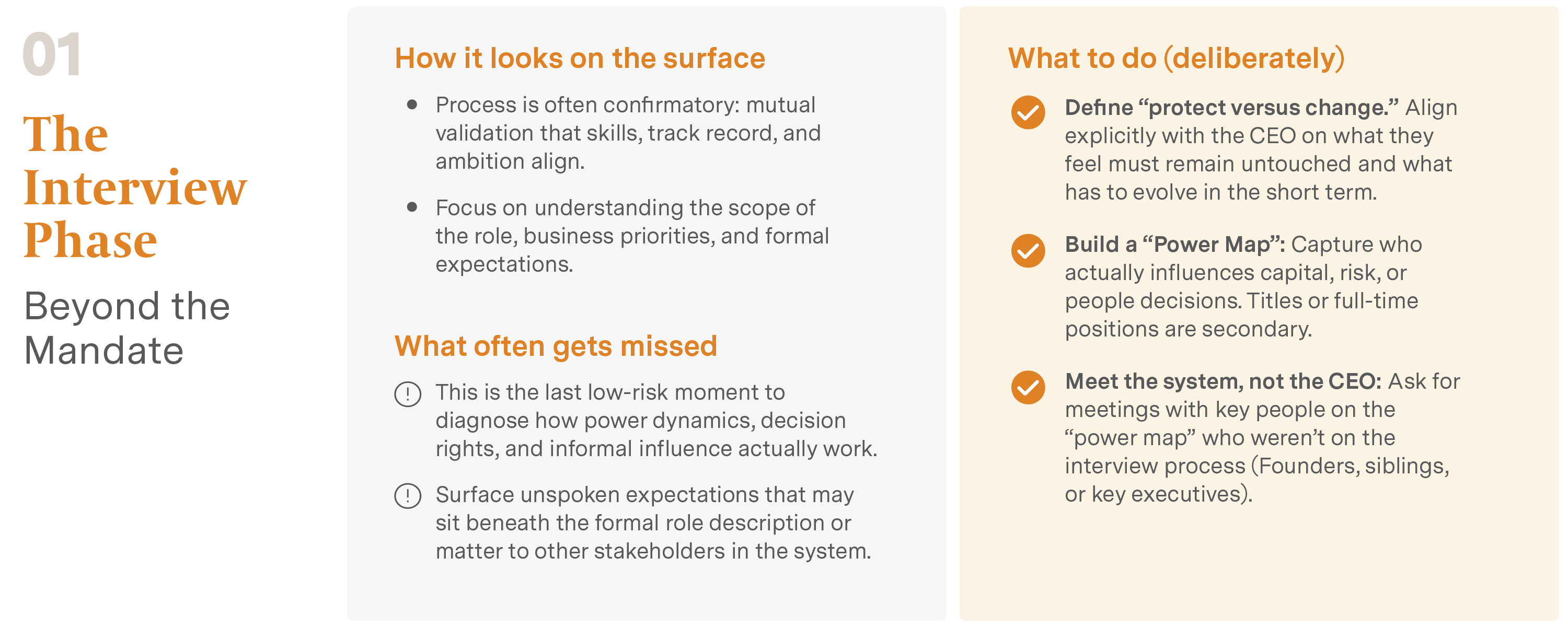
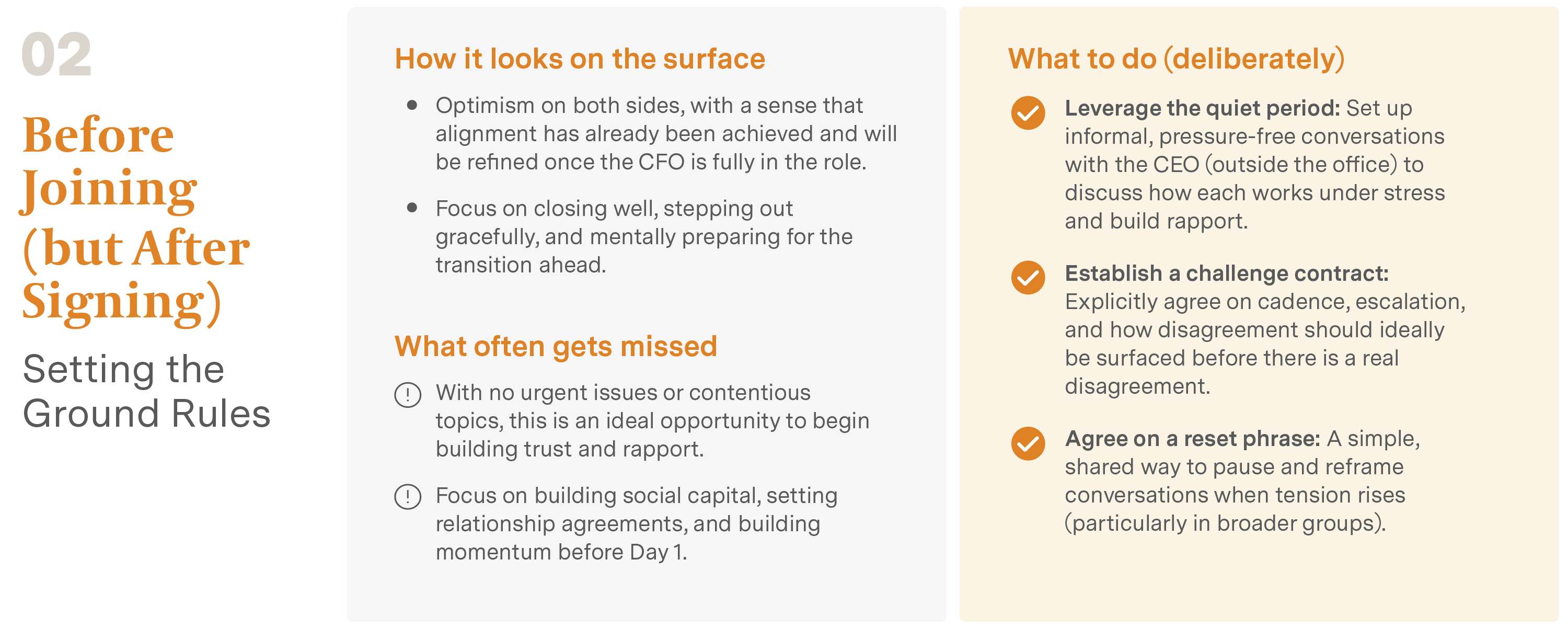
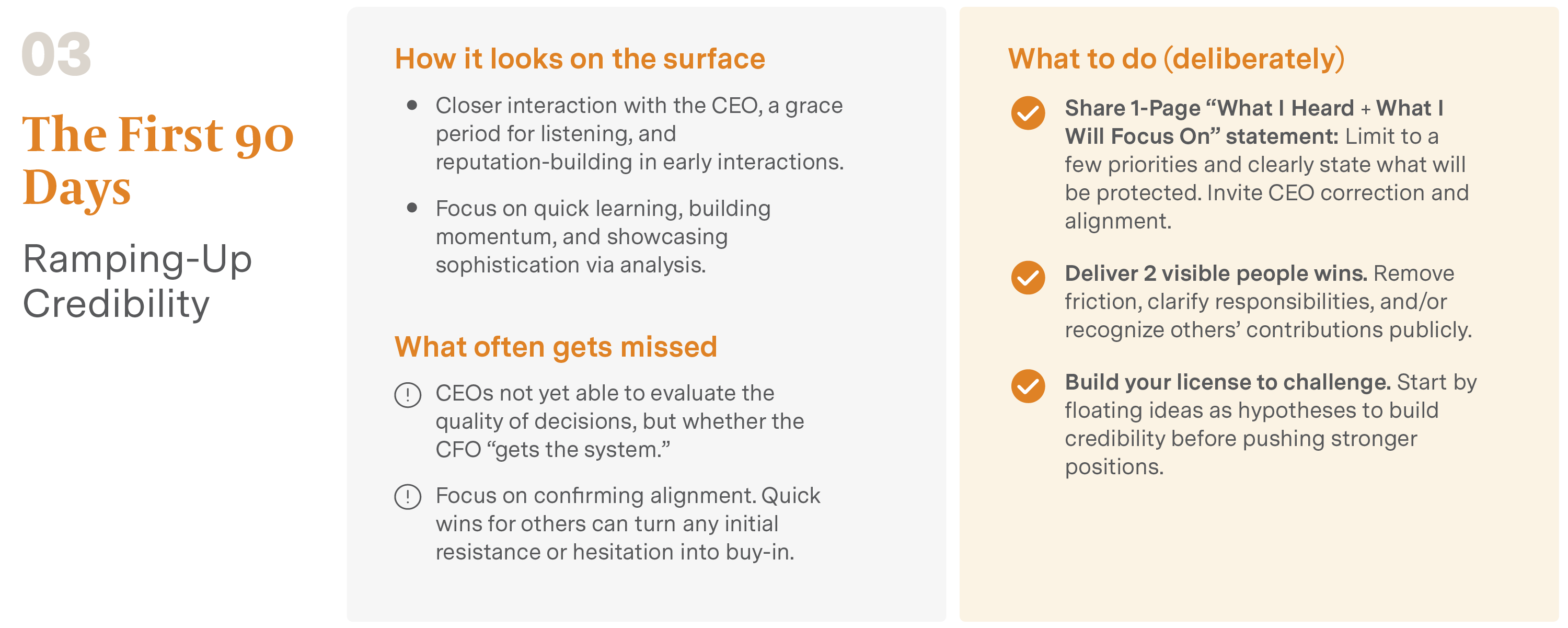
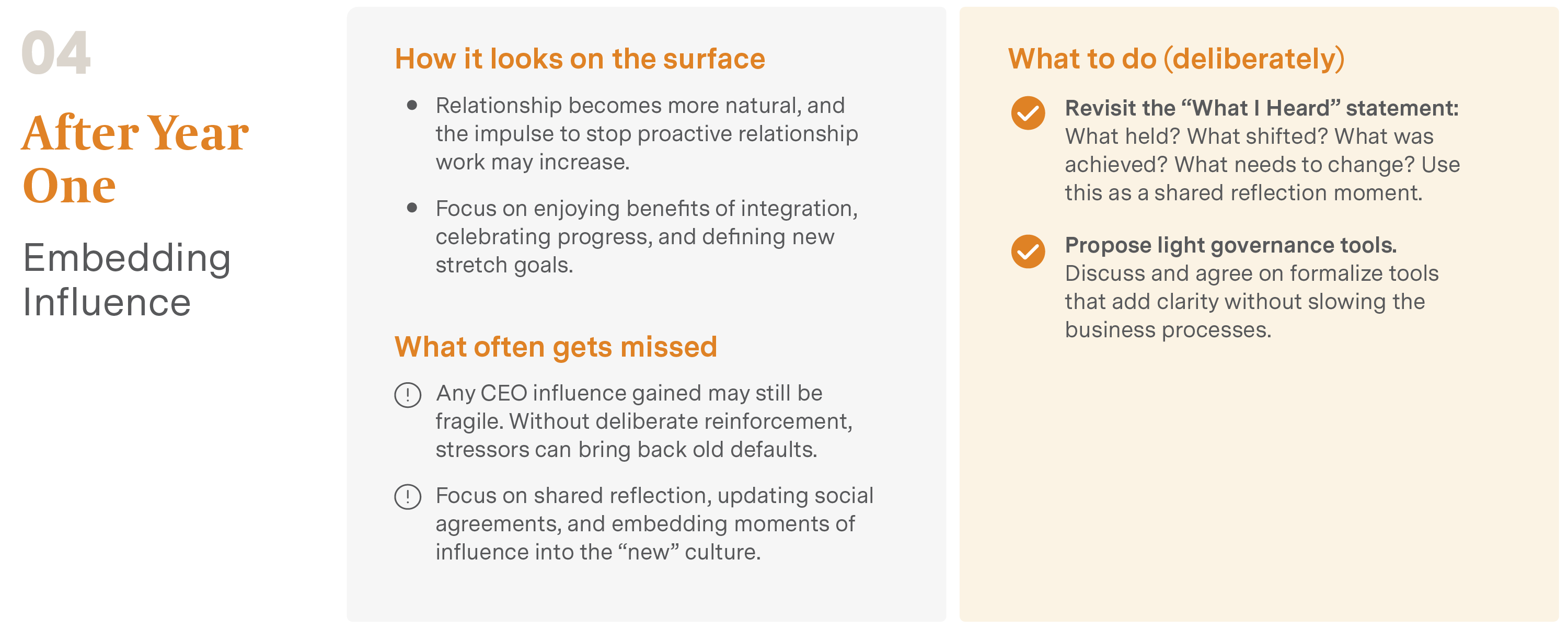
While every transition and company is unique, the underlying pattern for CFOs considering a transition into a CEO-owned company is often similar. What matters most is not doing more, but ensuring a few, explicit, often very human actions are done at the right moments. Those who best navigate this move tend to be intentional and proactive about making these moves early on.
To guide CFOs on this career path, we have outlined a roadmap that spans the interview phase, time before joining, first 90 days, and year-one reflection period. It surfaces what core opportunities often get missed at each stage, as well as practical suggested actions to ensure the move becomes a platform for success.
Where the Transition Ultimately Lands
Where the Transition Ultimately Lands
Handled thoughtfully, the move into an owner‑led business can become more than a successful transition. When expectations are surfaced early, trust is built deliberately, and influence is earned rather than imposed, the role begins to deliver on the promise that drew many CFOs to these firms in the first place.
Get the critical moments right, and the transition creates momentum instead of friction. The role stops feeling like a test to adapt quickly and more like the platform it was meant to be—one where influence is real, contributions are visible, and the rewards of operating alongside amazing owners are fully realized.
Get In Touch
If you are considering a transition into a CEO‑owned business—whether as a CFO or any other senior leadership role—or if you are in the midst of navigating one today, an external perspective can often help sharpen the path forward.
Likewise, for CEOs or Owners looking to attract and enable top talent, the question becomes not just who to hire, but how to create an environment where that talent can operate at its full potential.
At Egon Zehnder, we work closely with leaders on both sides of this equation—supporting executives who want to continue having an impact and partnering with CEOs to shape the conditions where trust and alignment can take hold quickly.
If a conversation would be useful, we would honor the opportunity to connect. Start a conversation.
