Download the full article
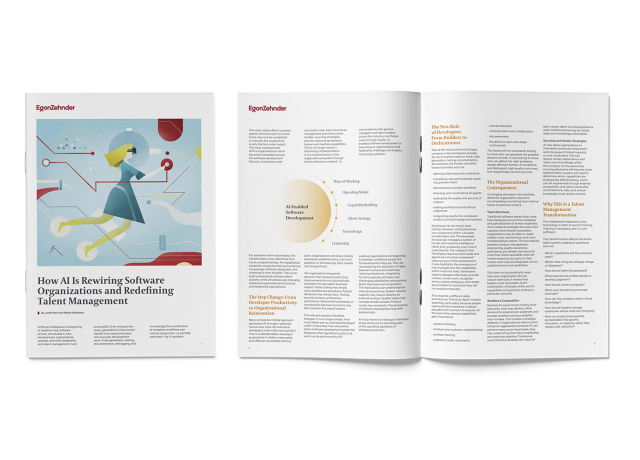
Explore how AI is reshaping software roles and what leaders must do to build future-ready talent.
Shaping Successions
Advancing Governance
Discovering Leaders
Developing Leadership
From code generation to the coordination of complete workflows, AI can now perform tasks that once took developers hours. Yet, as Judith Pertl and Wasko Rothmann argue, the real shift lies elsewhere. Faster coding often merely shifts bottlenecks elsewhere in the system, while cross‑functional decisions and coordination still take time. The question, then, is not how much faster individual developers can code, but how their role is changing – and what that implies for Talent Management.
Developers are becoming orchestrators. Their responsibilities now include setting goals and boundaries, translating business requirements into precise specifications, and evaluating the quality and safety of output. They still code, but they also steer a system of human and machine intelligence. This demands a different skill set: technical depth remains essential, but systems thinking, decision‑making under uncertainty, and communication and collaboration are growing in importance. Talent Management must therefore transform, and be considered from the outset by the CEO, CTO, CHRO and talent leadership. The central task will be to balance short‑term efficiency with long‑term capability‑building.
Established industrial firms face a particular challenge. While software increasingly shapes their products and business models, their talent and management systems often still follow an industrial logic built on long product life cycles, functional specialization and careful planning. By contrast, software work depends on rapid iteration, continuous deployment and decentralised technical decisions. AI adds another layer of complexity: firms must build modern software capabilities even as their understanding of software work is itself changing.
The article argues that these firms should develop a distinct model that combines industrial reliability with the speed of software‑driven work, rather than merely importing the talent practices of technology firms. Those that rethink how work is organized can secure a more fundamental competitive advantage.
Explore how AI is reshaping software roles and what leaders must do to build future-ready talent.
You are switching to an alternate language version of the Egon Zehnder website. The page you are currently on does not have a translated version. If you continue, you will be taken to the alternate language home page.
Continue to the website