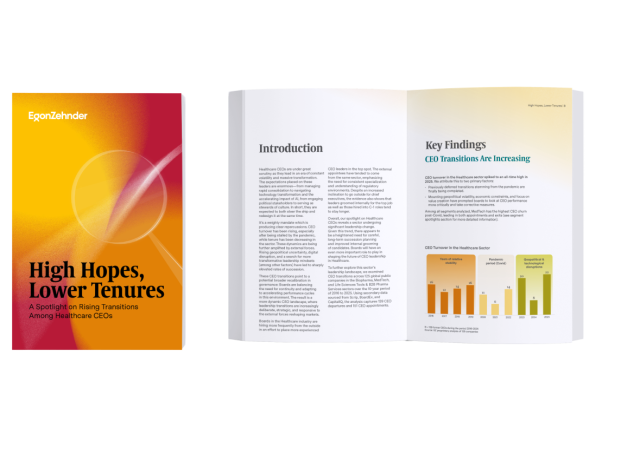
Healthcare CEOs are under intense scrutiny as they lead through constant volatility and large-scale transformation. Their mandate is expansive: managing rapid consolidation, navigating technological change and the accelerating impact of AI, engaging political stakeholders, and stewarding organizational culture. In short, they are expected to steer the ship while redesigning it. It is a weighty responsibility, and its effects are becoming clear.
This report examines CEO succession patterns across 125 global public companies in the Biopharma, MedTech, and B2B Pharma Services* sectors between 2016 and 2025. Drawing on 139 CEO departures and 151 CEO appointments, the findings reveal a sector experiencing heightened leadership turnover and evolving succession practices as boards respond to a rapidly changing environment.
These CEO transitions point to a potential broader recalibration in governance: Boards are balancing the need for continuity and adapting to accelerating performance cycles in this environment. The result is a more dynamic CEO landscape, where leadership transitions are increasingly deliberate, strategic, and responsive to the external forces reshaping markets.
*Includes CDMOs, CROs, LS Tools & Technologies.
Key Findings
Key Findings
CEO turnover reached record levels in 2025
Healthcare CEO transitions accelerated sharply following the delays brought on by the pandemic, with 22 departures in 2025 alone.
Boards are hiring externally more often
The average share of external CEO hires increased from 30% in the first half of the decade to 39.8% in the second half.
CEO tenures are shortening
The share of CEOs departing within four years of appointment rose from 29% between 2016–2020 to 34% between 2021–2025.
Internal succession still delivers advantages
Leaders developed internally and executives promoted from C-1 roles tend to remain in position longer, highlighting the value of sustained succession planning.
CEO selection is sector specialized
Most external CEO appointments came from within the same Healthcare segment, with 95% hired from within the sector and few crossing industry lines.
Demand for experienced CEOs is rising
Healthcare boards are increasingly favoring experienced leaders, with average appointment age rising from 49 to 58 over the decade.
The gender gap struggles to close
Only 9% of Healthcare CEOs are women. Over the past decade, there were three years in which no female CEOs were appointed (2016, 2023, and 2024).
Dive into a decade of CEO succession trends across 125 global Biopharma, MedTech, and Life Sciences Tools & B2B Pharma Services companies.